Can the way you handle unwanted thoughts and feelings predict how you will be doing at work a year from now?
In a study of 412 customer service centre workers in the United Kingdom, researchers measured acceptance: the willingness to experience thoughts, feelings and physical sensations without having to control them or let them determine one’s actions. Acceptance predicted better mental health and better performance on an objective measure one year later, over and above job control, locus of control and the general tendency to experience negative emotions (Bond & Bunce, 2003).
How people related to difficult feelings mattered, beyond how prone they were to having them.
Acceptance is one part of a broader skill that acceptance and commitment therapy (ACT) calls psychological flexibility. This article explains what it is, why it matters, where its limits are, and one tested exercise you can try.
What is psychological flexibility?
Definition
In acceptance and commitment therapy (ACT), psychological flexibility is the ability to stay in contact with the present moment, including uncomfortable thoughts and feelings, and to keep acting in line with what matters to you (Hayes et al., 2006).
It is not about feeling good all the time or forcing positive thoughts. It is about not letting painful inner experiences decide your next step.
In a broader view, psychological flexibility includes the abilities to recognise and adapt to changing situations, to shift mindsets or behaviour when they stop working, to keep balance among important areas of life, and to stay committed to behaviour that fits deeply held values (Kashdan & Rottenberg, 2010).
Its opposite, psychological inflexibility, often shows up as avoidance. Experiential avoidance is an unwillingness to stay in contact with certain aspects of experience, such as bodily arousal or strong emotions. In the short term, it spares us anxiety. In the longer term, it can get in the way of learning skills, progress and growth (Kashdan & Rottenberg, 2010).
Avoidance brings relief today, but over time it can make life smaller.
What are the six processes behind it?
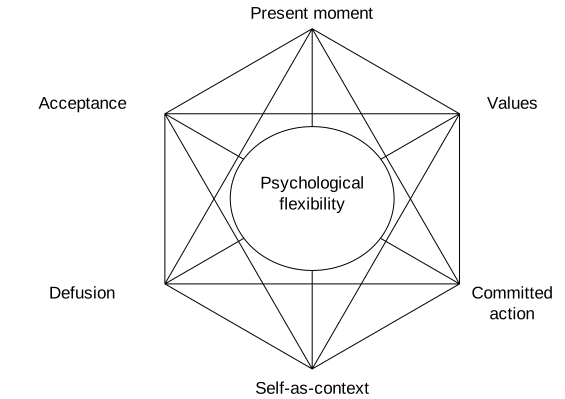

ACT describes psychological flexibility through six connected processes (Hayes et al., 2006):
- Acceptance: making room for feelings instead of fighting them.
- Cognitive defusion: noticing thoughts as thoughts, rather than as facts or orders.
- Contact with the present moment: paying attention to what is happening now.
- Self as context: a sense of self that is larger than any single thought or feeling.
- Values: knowing what you want your life to stand for.
- Committed action: taking concrete steps in that direction, even when it is hard.
The six processes can be applied to many concerns. One example is forgiveness, where each process can help people work with hurt and grudges.
Further reading: Forgiveness and Acceptance and Commitment Therapy: Letting Go Without Pretending It Was Fine
Why does it matter for wellbeing?
Kashdan and Rottenberg (2010) argued that psychological flexibility is a fundamental aspect of health. In many forms of psychological difficulty, they noted, these flexibility processes are absent.
Flexibility is especially relevant when life is uncertain or demanding. Dr. Soolmaz Dehghani’s research looks at psychological flexibility as a moderator: a factor that may change how strongly stressors such as intolerance of uncertainty or perfectionism are linked with distress and wellbeing. Her co-authored studies include work with university students, with women undergoing IVF and with nurses. You can find them on the publications page.
Further reading: Intolerance of Uncertainty: Why Not Knowing Feels So Hard
Can psychological flexibility be learned?
ACT is built on the idea that flexibility can be strengthened with practice (Hayes et al., 2006). It has been tested widely. A review of 20 meta-analyses, covering 12,477 participants, found ACT efficacious for all the conditions examined, including anxiety, depression, substance use and pain (Gloster et al., 2020).
Single processes can also be studied on their own. Defusion has its own exercise, described in the practice section below. Values have been studied outside ACT as well.
Study
In a laboratory experiment, 85 participants completed either a value-affirmation task, in which they reflected on their personal values, or a control task. They then took part in a laboratory stress challenge. Those who had affirmed their values showed significantly lower cortisol responses to stress than the control group (Creswell et al., 2005). The study comes from social psychology rather than ACT, but it suggests that reflecting on what matters can change how the body responds to stress.
Does flexibility mean putting up with everything?
No. Flexibility includes recognising what a situation demands and changing strategy when the current one is not working (Kashdan & Rottenberg, 2010). The same authors question whether any way of regulating emotions brings benefits in every situation, rather than benefits that depend on the situation and on our values and goals.
In the call centre study, having more control over one’s job was more beneficial for people with higher acceptance (Bond & Bunce, 2003). Acceptance worked together with job control, not instead of it.
Accepting a feeling is not the same as accepting a situation.
If you are in a situation that is unsafe, or your distress is severe, a self-help exercise is not enough. Please speak with a qualified professional.
Try it: the word repetition exercise
One of the oldest tested defusion exercises was first described by the psychologist Edward Titchener nearly 90 years before it was studied: rapidly repeating a single word (Masuda et al., 2004).
In a series of eight single-case experiments, repeating a one-word version of a negative thought about oneself reduced both the discomfort and the believability of that thought more than a distraction task or a thought control task (Masuda et al., 2004). A randomised study with university students found the same advantage over thought distraction, including for participants with elevated depressive symptoms (Masuda et al., 2010).
A further study varied how long people repeated the word. The effect on discomfort levelled off after 3 to 10 seconds, and the effect on believability after 20 to 30 seconds (Masuda et al., 2009).
Exercise
- Choose one thought. Pick a negative thought about yourself that bothers you, and sum it up in a single word.
- Notice it. Note how uncomfortable the thought feels and how much you believe it right now.
- Repeat the word. Say the word aloud, quickly and over and over, for about 20 to 30 seconds.
- Notice it again. Note how uncomfortable and how believable the thought feels now.
(Word repetition technique as tested by Masuda et al., 2004, 2009.)
The aim is not to get rid of the thought. Defusion changes the context in which a thought occurs, rather than trying to change its form or how often it appears (Masuda et al., 2004). These were short laboratory studies, so treat the exercise as a way to practise noticing, not as a treatment. If it leaves you feeling worse, stop and speak with a professional.
Two questions to reflect on:
- Which thought about yourself shows up most often when things get hard?
- When that thought loosens its grip, what step would you take that fits what matters to you?
Common questions
Is psychological flexibility the same as resilience?
They are closely related. Research on psychological flexibility has appeared under several names, including ego-resiliency, and ACT research extends that earlier concept (Kashdan & Rottenberg, 2010). Psychological flexibility focuses on how you relate to thoughts and feelings in the moment while acting on your values (Hayes et al., 2006).
Is psychological flexibility the same as positive thinking?
No. Kashdan and Rottenberg (2010) describe psychologically flexible people as relying on personally meaningful values to guide their decisions, instead of spending energy on reaching the “perfect mix” of positive and negative thoughts and feelings.
When should I look for support?
If avoidance, worry or low mood are limiting your work, relationships or sleep, talking with a qualified professional can help.
References
- Bond, F. W., & Bunce, D. (2003). The role of acceptance and job control in mental health, job satisfaction, and work performance. Journal of Applied Psychology, 88(6), 1057-1067. https://doi.org/10.1037/0021-9010.88.6.1057
- Creswell, J. D., Welch, W. T., Taylor, S. E., Sherman, D. K., Gruenewald, T. L., & Mann, T. (2005). Affirmation of personal values buffers neuroendocrine and psychological stress responses. Psychological Science, 16(11), 846-851. https://doi.org/10.1111/j.1467-9280.2005.01624.x
- Gloster, A. T., Walder, N., Levin, M. E., Twohig, M. P., & Karekla, M. (2020). The empirical status of acceptance and commitment therapy: A review of meta-analyses. Journal of Contextual Behavioral Science, 18, 181-192. https://doi.org/10.1016/j.jcbs.2020.09.009
- Hayes, S. C., Luoma, J. B., Bond, F. W., Masuda, A., & Lillis, J. (2006). Acceptance and commitment therapy: Model, processes and outcomes. Behaviour Research and Therapy, 44(1), 1-25. https://doi.org/10.1016/j.brat.2005.06.006
- Kashdan, T. B., & Rottenberg, J. (2010). Psychological flexibility as a fundamental aspect of health. Clinical Psychology Review, 30(7), 865-878. https://doi.org/10.1016/j.cpr.2010.03.001
- Masuda, A., Hayes, S. C., Sackett, C. F., & Twohig, M. P. (2004). Cognitive defusion and self-relevant negative thoughts: Examining the impact of a ninety year old technique. Behaviour Research and Therapy, 42(4), 477-485. https://doi.org/10.1016/j.brat.2003.10.008
- Masuda, A., Hayes, S. C., Twohig, M. P., Drossel, C., Lillis, J., & Washio, Y. (2009). A parametric study of cognitive defusion and the believability and discomfort of negative self-relevant thoughts. Behavior Modification, 33(2), 250-262. https://doi.org/10.1177/0145445508326259
- Masuda, A., Twohig, M. P., Stormo, A. R., Feinstein, A. B., Chou, Y.-Y., & Wendell, J. W. (2010). The effects of cognitive defusion and thought distraction on emotional discomfort and believability of negative self-referential thoughts. Journal of Behavior Therapy and Experimental Psychiatry, 41(1), 11-17. https://doi.org/10.1016/j.jbtep.2009.08.006