A 2026 systematic review and meta-analysis examined 44 studies on doomscrolling. It found positive correlations with anxiety, depression and psychological distress (Li & Yin, 2026). Yet the same paper rated the certainty of evidence as “very low” for all five outcomes and states that the evidence does not establish causality.
Both statements hold at once, and reading either alone is misleading. If we look only at the correlations, we might conclude that bad news makes us anxious. If we look only at the limitations, we might dismiss the association entirely.
This article explains what doomscrolling is, what the reviewed studies found, and why those findings cannot be read as cause and effect. The evidence section rests on the abstracts of two papers, not their full texts.
What is doomscrolling, and what is it not?
In the review by Li and Yin (2026), doomscrolling is persistent or repetitive engagement with predominantly negative, threatening or distressing online information, often accompanied by difficulty disengaging.
Definition: doomscrolling
The review describes it as repeated or sustained engagement with negative online content, together with difficulty stopping. The authors stress that it overlaps with problematic social media use, general negative-news exposure and problematic internet use, but is not interchangeable with them.
Reading one upsetting story, or spending a lot of time on social media, is therefore not doomscrolling in itself. What distinguishes it is the repeated pattern and the difficulty of stopping.
What does the evidence say?
In the meta-analysis by Li and Yin (2026), 21 studies (23 independent analytic samples) contributed to five primary analyses. Reported correlations with doomscrolling were:
- Anxiety: r = 0.35
- Depression: r = 0.35
- Psychological distress: r = 0.51
- Lower psychological well-being: r = -0.29
- Lower life satisfaction: r = -0.25
A study: the systematic review and meta-analysis by Li and Yin (2026)
The authors searched nine sources through 20 May 2026 and included 44 reports. They pooled correlations reported in the papers with a random-effects model and rated certainty with GRADE. Heterogeneity was high in every domain. For psychological distress, I² was 86.5%, and four of the five contributing studies came from Türkiye. Result: an association exists, but certainty is very low for all five outcomes.
A separate study of university students reported a positive but smaller relationship. In Sultana et al. (2026), the correlation between doomscrolling and psychological distress was r = .22, and the regression model, which also included resilience, explained only 2.1% of the variance in distress.
This shows the difference between a result being statistically significant and being large. An association can be significant and still explain only a small part of the differences between people.
Why does correlation not show causation?
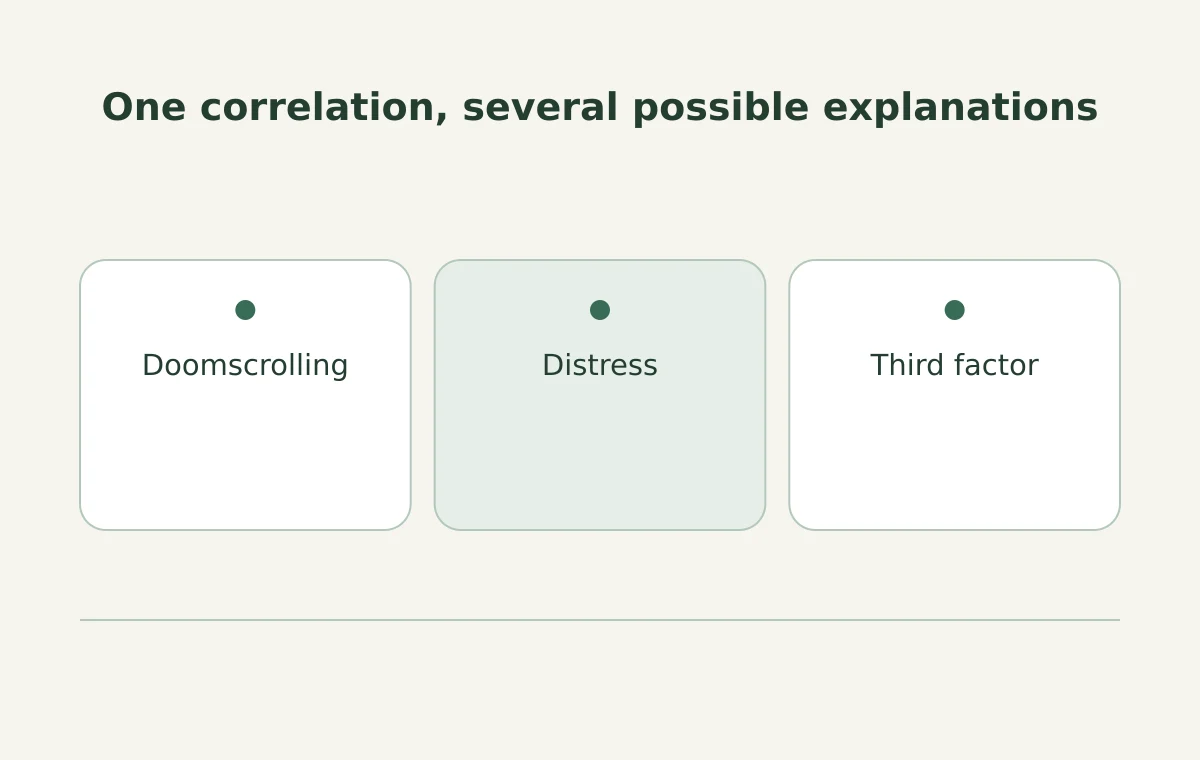
A correlation means two things vary together, not that one produces the other. The meta-analysis authors point to the largely cross-sectional designs and residual confounding, and state plainly that causality is not established.
The same data fit at least three logical explanations, none of which these sources tested:
- Doomscrolling could increase distress.
- People who are anxious or distressed might seek out more news.
- A third factor, such as life stress or personality traits, could shift both at once.
Separating these requires longitudinal studies, momentary assessment in daily life, and experiments. The authors of the meta-analysis recommend the same.
Why is the pattern described as hard to stop?
Difficulty disengaging is part of the definition itself. But the sources reviewed for this article did not test the mechanism behind that difficulty.
Sultana et al. (2026) studied doomscrolling in students during periods of uncertainty. That suggests a testable hypothesis: perhaps not knowing, that is, low tolerance of uncertainty, feeds continued news-seeking. This is only a hypothesis, not an established finding.
Limits and cautions
- Most data are correlational, and the direction of the relationship is unknown.
- Heterogeneity was high, and for psychological distress most studies came from one country, so generalizing across cultures calls for caution.
- The second study sampled university students and cannot be generalized to every population.
- This article makes no claims about doomscrolling and sleep, or about the effectiveness of strategies to reduce it, because no suitable source was reviewed.
- This text is not a diagnosis or treatment and does not replace individual assessment.
Questions for reflection
These questions are not a therapeutic intervention. They are only meant to help you see your own pattern more precisely:
- Does repeatedly reading bad news come with difficulty stopping for you, or is it simply news consumption?
- How do you feel before you start, and what changes once you finish?
Frequently asked questions
Is doomscrolling a diagnosable disorder?
In the sources reviewed for this article, it is not presented as a clinical diagnosis. The review describes it as a pattern of engagement with negative content that overlaps with other constructs.
Is reading bad news always harmful?
The evidence above concerns a repeated pattern with difficulty disengaging, not every kind of news reading. These sources do not show that all news consumption is harmful.
What should I do if I think I doomscroll and feel distressed?
This article cannot assess your situation. If distress continues or interferes with daily life, speak with a mental health professional.
References
- Li, Q., & Yin, X. (2026). Doomscrolling, mental health, and psychological well-being in adolescents and adults: a systematic review and meta-analysis. Frontiers in Psychology. https://doi.org/10.3389/fpsyg.2026.1893800
- Sultana, A., Tanvir, S., Munir, B., & Waqar, A. (2026). Doomscrolling, Resilience and Psychological Distress during Uncertainty. Pakistan Journal of Positive Psychology. https://doi.org/10.67785/pjpp.5.287