What happens in your body when you hold on to a grudge?
In one experiment, 71 adults brought to mind a real person who had hurt them. When they replayed the hurt and nursed the grudge, their heart rate, blood pressure, skin conductance and brow muscle tension rose more than when they imagined understanding and forgiving that person (Witvliet et al., 2001).
A grudge is not only a thought. The body carries it too.
This article looks at what forgiveness is and is not, what research shows about learning it, and how acceptance and commitment therapy (ACT) can help, without pretending that what happened was fine.
What is forgiveness, and what is it not?
Researchers distinguish two kinds of forgiveness.
Definition
Decisional forgiveness is an intention to give up an unforgiving stance and to respond differently towards the person who caused the hurt, for example by not seeking revenge. Emotional forgiveness is a gradual replacement of resentment and bitterness with more positive, other-oriented emotions such as empathy or compassion (Worthington et al., 2007).
A decision to forgive can be made relatively quickly. Emotional forgiveness usually unfolds more slowly, and it is more directly linked with health and wellbeing (Worthington et al., 2007).
Forgiveness is also not the same as reconciliation (Freedman, 1998). You can forgive someone and still decide not to continue the relationship. Forgiving does not mean forgetting or excusing what happened.
Does forgiveness help, and how do we know?
Forgiveness can be learned. A meta-analysis of 54 research reports found that people who received therapy designed to promote forgiveness reported more forgiveness than people who received no treatment or other treatments. They also improved more in depression, anxiety and hope. Longer interventions, and individual rather than group formats, tended to work better (Wade et al., 2014).
A meta-analysis of randomised controlled trials found that process-based forgiveness interventions reduced depression, anger and hostility, and stress and distress, and increased positive affect (Akhtar & Barlow, 2018).
Study
In an early trial, 12 women who had survived incest met individually with a therapist once a week, for an average of about 14 months, and worked through a process model of forgiveness towards the abuser. Compared with a waiting-list group, they gained more in forgiveness and hope and showed greater decreases in anxiety and depression. When the waiting group began the programme, they showed similar changes (Freedman & Enright, 1996). Forgiveness here was a goal the women chose, supported over a long period, not a quick instruction.
Even brief, self-guided help can work.
Study
In a multisite trial, 4,598 adults in Colombia, Hong Kong, Indonesia, South Africa and Ukraine who had experienced an interpersonal hurt were randomly assigned to complete a short self-directed forgiveness workbook immediately or two weeks later. Two weeks after assignment, the workbook group showed less unforgiveness and lower depression and anxiety symptoms than the waiting group (Ho et al., 2024). The effects on depression and anxiety were small and the follow-up was short, but the trial shows that forgiveness can be supported at scale.
Forgiveness is also linked with health. A meta-analysis of 103 samples, with more than 26,000 participants from 17 countries, found a reliable association between forgiveness and health. The link was stronger for psychological than for physical health, although associations with heart rate and blood pressure were robust (Rasmussen et al., 2019).
How does forgiveness shape conflict in couples?
In two studies of married couples, wives’ benevolence, meaning goodwill towards the partner after a hurt, predicted husbands’ reports of better conflict resolution. Husbands’ wish to retaliate, and in longer marriages their tendency to avoid the partner, predicted poorer conflict resolution as reported by wives. These links held regardless of how satisfied the spouses were with the marriage (Fincham et al., 2004).
Further reading: Mindful Communication for Couples
Where does acceptance and commitment therapy fit in?
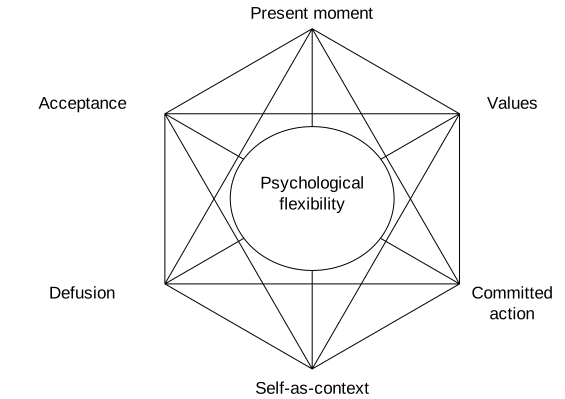

ACT aims to build psychological flexibility: the ability to stay in contact with difficult thoughts and feelings while choosing actions that reflect what matters to us (Hayes et al., 2006). A review of 20 meta-analyses, covering more than 12,000 participants, found ACT efficacious for anxiety, depression, substance use, pain and a range of other difficulties (Gloster et al., 2020).
ACT is not a forgiveness therapy, and it does not set forgiveness as a goal that must be reached. Its processes, however, fit closely with what forgiveness research describes. Bem and colleagues (2021), writing in the main journal of the ACT research community, proposed psychological flexibility as a unifying framework for understanding self-forgiveness, including for people stuck in chronic guilt or shame.
The table shows how the six core ACT processes can apply to forgiveness. It is a way of organising clinical thinking, not a tested treatment model.
| ACT process | In the context of forgiveness |
|---|---|
| Acceptance | Making room for hurt and anger, instead of suppressing them or pretending to be “over it” |
| Cognitive defusion | Seeing the replayed story of the hurt as a story the mind tells, not a command to act on |
| Contact with the present moment | Noticing when the mind has drifted back into the past event |
| Self-as-context | Recognising “I was hurt” without the hurt becoming the whole of who I am |
| Values | Asking what kind of person, and what kind of relationships, I want to have from here |
| Committed action | Taking concrete steps, which may include a conversation, a boundary, or letting go of revenge |
Defusion matters most here. In three longitudinal studies, increases in rumination about a hurt were followed by decreases in forgiveness, and this link appeared to work through anger towards the offender (McCullough et al., 2007). ACT does not try to stop such thoughts. It loosens their grip, so that the replayed story does not decide what we do next.
Values connect naturally with decisional forgiveness. A decision to stop pursuing revenge is not a feeling; it is a choice about how to act.
Further reading: Psychological Flexibility: What It Is and How to Build It
What about forgiving yourself?
Sometimes the hardest person to forgive is ourselves. Genuine self-forgiveness is different from simply feeling better.
In two studies, accepting responsibility for a wrongdoing went together with lower self-regard, unless people reaffirmed the values they had violated, for example by acknowledging the wrongdoing to the person they had hurt (Wenzel et al., 2012).
A later study described two routes to self-forgiveness (Woodyatt et al., 2017). Self-compassion reduced self-punishment and increased feelings of self-forgiveness. Reaffirming the violated values supported a more genuine process, reduced defensiveness, and increased the wish to reconcile and to make amends. Both routes resemble ACT: self-compassion is close to acceptance, and value reaffirmation is close to values-based action.
Study
Self-blame often comes with harsh thoughts about oneself. One of the oldest defusion exercises is to choose a single word that captures such a thought and repeat it aloud, quickly and over and over, until it begins to sound like just a sound. In a series of single-case experiments, this exercise reduced both the discomfort and the believability of negative thoughts about oneself more than distraction or trying to control the thought (Masuda et al., 2004).
When is forgiveness not the right step?
Forgiveness is not always the right step at a given moment, and it must never be pressured.
In a longitudinal study of newlywed couples, spouses who were more forgiving experienced psychological and physical aggression from their partners that remained stable over four years, while less forgiving spouses saw such aggression decline (McNulty, 2011). Forgiveness without accountability can make it easier for harmful behaviour to continue.
If you are in a relationship where you feel unsafe, your safety comes first. Forgiveness, if it comes at all, can come later and does not require staying.
Try it: the five REACH steps
The workbook tested in the multisite trial took 2 to 3 hours (Ho et al., 2024). Participants first described the hardest hurt they had already forgiven, chose one hurt to work on, and learned the difference between decisional and emotional forgiveness. They then worked through five steps of emotional forgiveness.
Exercise
- Recall the hurt. Remember what happened honestly, without minimising it.
- Empathise with the person who caused it. Try to understand, without excusing, what may have led to their behaviour.
- Give an altruistic gift. Offer forgiveness as an undeserved gift, not as something the other person has earned.
- Commit to the forgiveness you have experienced.
- Hold on to forgiveness. Return to your commitment when the hurt and doubts come back.
Finally, consider a decision to forgive, and apply what you learned to another hurt. (Steps from the REACH Forgiveness workbook, as described in Ho et al., 2024.)
ACT can support each step: acceptance makes it easier to recall the hurt without being overwhelmed, defusion helps when grievance thoughts return, and values give the commitment its direction. If the hurt involved abuse or continuing danger, work through the steps with a professional.
Two questions to reflect on:
- Which hurt in your life have you already forgiven, and what helped you do it?
- In the hurt you are working on now, has your decision to forgive come before your feelings have changed?
Common questions
Do I have to reconcile with the person I forgive?
No. Forgiveness and reconciliation are different processes (Freedman, 1998). Reconciliation requires trust and, usually, a change in the other person’s behaviour.
What if I have decided to forgive but still feel angry?
That is common. Decisional and emotional forgiveness often unfold at different speeds (Worthington et al., 2007). In ACT terms, the feeling can be accepted while you continue to act on your decision.
Is self-forgiveness the same as letting myself off the hook?
No. Genuine self-forgiveness involves accepting responsibility and recommitting to the values that were violated (Wenzel et al., 2012; Woodyatt et al., 2017).
References
- Akhtar, S., & Barlow, J. (2018). Forgiveness therapy for the promotion of mental well-being: A systematic review and meta-analysis. Trauma, Violence, & Abuse, 19(1), 107-122. https://doi.org/10.1177/1524838016637079
- Bem, J. R., Strelan, P., & Proeve, M. (2021). Roads less travelled to self-forgiveness: Can psychological flexibility overcome chronic guilt/shame to achieve genuine self-forgiveness? Journal of Contextual Behavioral Science, 21, 203-211. https://doi.org/10.1016/j.jcbs.2021.08.001
- Fincham, F. D., Beach, S. R. H., & Davila, J. (2004). Forgiveness and conflict resolution in marriage. Journal of Family Psychology, 18(1), 72-81. https://doi.org/10.1037/0893-3200.18.1.72
- Freedman, S. (1998). Forgiveness and reconciliation: The importance of understanding how they differ. Counseling and Values, 42(3), 200-216. https://doi.org/10.1163/2161007x-04203007
- Freedman, S. R., & Enright, R. D. (1996). Forgiveness as an intervention goal with incest survivors. Journal of Consulting and Clinical Psychology, 64(5), 983-992. https://doi.org/10.1037/0022-006X.64.5.983
- Gloster, A. T., Walder, N., Levin, M. E., Twohig, M. P., & Karekla, M. (2020). The empirical status of acceptance and commitment therapy: A review of meta-analyses. Journal of Contextual Behavioral Science, 18, 181-192. https://doi.org/10.1016/j.jcbs.2020.09.009
- Hayes, S. C., Luoma, J. B., Bond, F. W., Masuda, A., & Lillis, J. (2006). Acceptance and commitment therapy: Model, processes and outcomes. Behaviour Research and Therapy, 44(1), 1-25. https://doi.org/10.1016/j.brat.2005.06.006
- Ho, M. Y., Worthington, E. L., Jr., Cowden, R. G., Bechara, A. O., Chen, Z. J., Gunatirin, E. Y., Joynt, S., Khalanskyi, V. V., Korzhov, H., Kurniati, N. M. T., Rodriguez, N., Salnykova, A., Shtanko, L., Tymchenko, S., Voytenko, V. L., Zulkaida, A., Mathur, M. B., & VanderWeele, T. J. (2024). International REACH forgiveness intervention: A multisite randomised controlled trial. BMJ Public Health, 2(1), e000072. https://doi.org/10.1136/bmjph-2023-000072
- Masuda, A., Hayes, S. C., Sackett, C. F., & Twohig, M. P. (2004). Cognitive defusion and self-relevant negative thoughts: Examining the impact of a ninety year old technique. Behaviour Research and Therapy, 42(4), 477-485. https://doi.org/10.1016/j.brat.2003.10.008
- McCullough, M. E., Bono, G., & Root, L. M. (2007). Rumination, emotion, and forgiveness: Three longitudinal studies. Journal of Personality and Social Psychology, 92(3), 490-505. https://doi.org/10.1037/0022-3514.92.3.490
- McNulty, J. K. (2011). The dark side of forgiveness: The tendency to forgive predicts continued psychological and physical aggression in marriage. Personality and Social Psychology Bulletin, 37(6), 770-783. https://doi.org/10.1177/0146167211407077
- Rasmussen, K. R., Stackhouse, M., Boon, S. D., Comstock, K., & Ross, R. (2019). Meta-analytic connections between forgiveness and health: The moderating effects of forgiveness-related distinctions. Psychology & Health, 34(5), 515-534. https://doi.org/10.1080/08870446.2018.1545906
- Wade, N. G., Hoyt, W. T., Kidwell, J. E. M., & Worthington, E. L., Jr. (2014). Efficacy of psychotherapeutic interventions to promote forgiveness: A meta-analysis. Journal of Consulting and Clinical Psychology, 82(1), 154-170. https://doi.org/10.1037/a0035268
- Wenzel, M., Woodyatt, L., & Hedrick, K. (2012). No genuine self-forgiveness without accepting responsibility: Value reaffirmation as a key to maintaining positive self-regard. European Journal of Social Psychology, 42(5), 617-627. https://doi.org/10.1002/ejsp.1873
- Witvliet, C. V. O., Ludwig, T. E., & Vander Laan, K. L. (2001). Granting forgiveness or harboring grudges: Implications for emotion, physiology, and health. Psychological Science, 12(2), 117-123. https://doi.org/10.1111/1467-9280.00320
- Woodyatt, L., Wenzel, M., & Ferber, M. (2017). Two pathways to self-forgiveness: A hedonic path via self-compassion and a eudaimonic path via the reaffirmation of violated values. British Journal of Social Psychology, 56(3), 515-536. https://doi.org/10.1111/bjso.12194
- Worthington, E. L., Jr., Witvliet, C. V. O., Pietrini, P., & Miller, A. J. (2007). Forgiveness, health, and well-being: A review of evidence for emotional versus decisional forgiveness, dispositional forgivingness, and reduced unforgiveness. Journal of Behavioral Medicine, 30(4), 291-302. https://doi.org/10.1007/s10865-007-9105-8