What makes waiting so stressful: the bad news itself, or not knowing?
In a laboratory study, 45 adults played a learning game. On each turn they saw one of two rocks and guessed whether a snake was hiding underneath. Every snake came with a painful electric shock to the hand, and the odds behind each rock kept changing. The shocks raised stress, but so did uncertainty: participants’ stress ratings, pupil size and skin conductance rose and fell with how unpredictable the outcome was, and uncertainty was greatest when a snake seemed as likely as not (de Berker et al., 2016).
Stress followed not only the shocks, but also not knowing.
Some people find that state of not knowing especially hard to bear. Psychologists call this intolerance of uncertainty. This article explains what it is, how it shows up in daily life, what treatment research shows, and one tested technique you can try.
What is intolerance of uncertainty?
Definition
Intolerance of uncertainty is a dispositional difficulty in enduring the unpleasant response that is triggered when key information is missing (Carleton, 2016).
In other words, uncertain situations feel threatening and hard to endure, even when the chance of a bad outcome is small.
The concept was first studied in relation to worry (Freeston et al., 1994). It is now seen as relevant across anxiety, low mood and several other difficulties (Carleton, 2016).
Does it actually make people worry more?
Knowing that two things go together does not show which one comes first. One early experiment tested this by changing intolerance of uncertainty directly.
Study
Researchers used a gambling task to raise intolerance of uncertainty in one group of 21 participants and to lower it in another group of 21. Participants whose intolerance of uncertainty had been raised then reported more worry than those whose intolerance had been lowered (Ladouceur et al., 2000). The authors saw this as initial evidence that intolerance of uncertainty plays a causal part in worry.
The groups were small and the change was brief, so this is a first step, not final proof. It does suggest that the way we relate to uncertainty can feed worry, not only follow from it.
How does it show up in daily life?
One common response to uncertainty is to look for more information.
In an experiment with 153 university students, researchers led some participants to believe they were highly intolerant of uncertainty and then gave everyone information about a fictitious infection, written to be either more or less uncertain. Students in the high intolerance and high uncertainty condition sought the most information, and they also worried the most about the uncertainty (Rosen & Knäuper, 2009).
Researchers who treat excessive worry describe other certainty-seeking habits, which they call safety behaviours: for example, seeking reassurance from others, or overpreparing for a task. Worry itself can serve the same purpose, because thinking through many possible bad outcomes can make the future feel less uncertain (Dugas et al., 2022).
Certainty-seeking habits bring short-term relief, but they get in the way of learning that you can cope with not knowing (Dugas et al., 2022). Over time, this keeps intolerance of uncertainty going.
How do uncertainty, stress and flexibility fit together?
Dr. Soolmaz Dehghani’s research examines intolerance of uncertainty together with psychological flexibility. Her co-authored studies have examined psychological flexibility as a moderator in the relationship between intolerance of uncertainty and flourishing, and between intolerance of uncertainty and perceived stress among women undergoing IVF. Another study examined intolerance of uncertainty as a mediator between perfectionism and depressive symptoms in female university students. See the publications page for the full list.
Further reading: Psychological Flexibility: What It Is and How to Build It
Further reading: Emotional Wellbeing During IVF: Coping With Stress and Uncertainty
Can intolerance of uncertainty change?
Yes. A meta-analysis of 28 randomised controlled trials found that evidence-based treatments for anxiety-related disorders had a large effect on intolerance of uncertainty compared with control conditions. Improvements in intolerance of uncertainty went together with improvements in symptom severity, and accounted for 36% of the variance (Miller & McGuire, 2023).
Some treatments focus on uncertainty alone. One protocol has three parts over 12 sessions: learning about uncertainty and noticing one’s own responses to it, behavioural experiments, and relapse prevention. In a first test with seven people with generalised anxiety disorder (GAD), symptoms and intolerance of uncertainty decreased substantially, and the gains were generally maintained six months later (Hebert & Dugas, 2019).
Study
In a randomised trial, 60 adults with GAD received either 12 weekly one-hour sessions of behavioural experiments for intolerance of uncertainty, or were placed on a waiting list. The treatment group improved more than the waiting group in the severity of GAD, worry, depression, physical symptoms of anxiety and intolerance of uncertainty. Gains were maintained or increased over a 12-month follow-up (Dugas et al., 2022).
When is self-help not enough?
The behavioural experiments in these studies were carried out with a therapist, over several weeks, by adults diagnosed with GAD (Dugas et al., 2022; Hebert & Dugas, 2019). A single experiment at home is a way to practise, not a treatment.
If worry takes up much of your day, disturbs your sleep or keeps you from work and relationships, please speak with a qualified professional.
Try it: a behavioural experiment with uncertainty
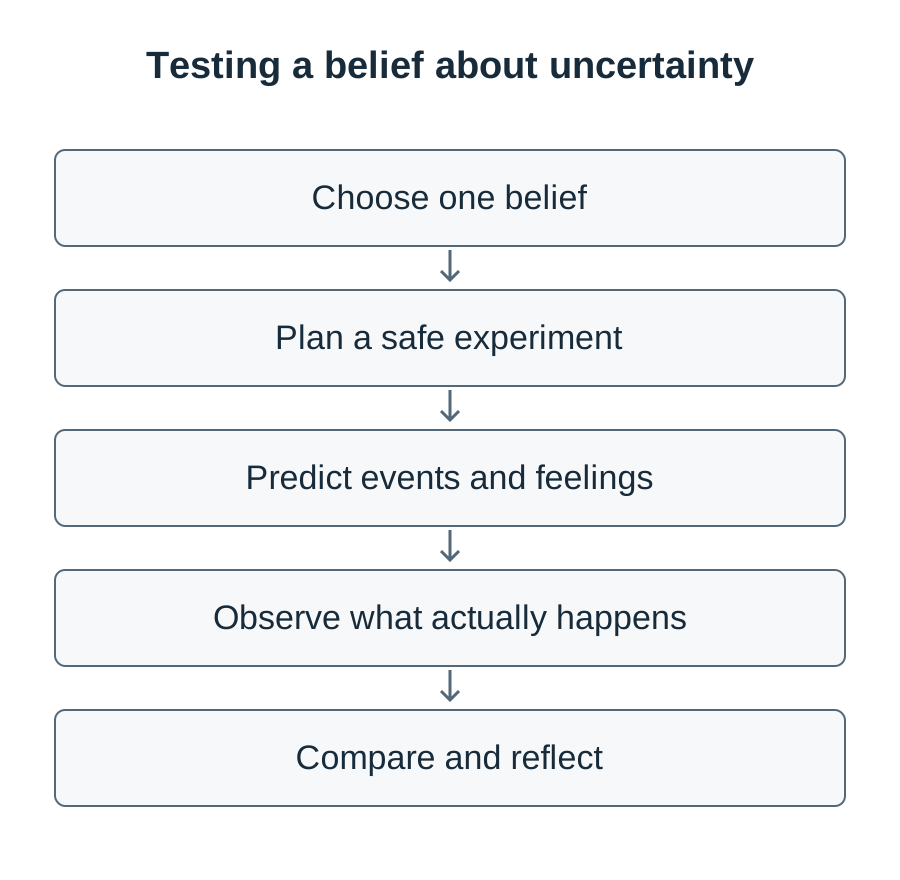
A behavioural experiment asks you to make a specific prediction before you enter an uncertain situation, and then to check it against what actually happens (Dugas et al., 2022). The aim is to learn something new about uncertainty from direct experience.
In the trial, participants first learned that worry, anxiety and safety behaviours are normal reactions to uncertainty, and began monitoring their own responses. They then ran a series of experiments, one at a time (Dugas et al., 2022).
Exercise
- Choose a belief to test. Pick one specific belief about uncertainty. An example from the trial: “uncertainty at work makes it impossible to be productive”.
- Design the experiment. Plan in detail a situation that tests the belief by dropping a certainty-seeking habit. In the trial’s example, the person took on new responsibilities at work that they had been avoiding.
- Make two predictions. Write down what you think will happen, and how you think you will feel.
- Run it and watch. Carry out the experiment and note what actually happened, and how you actually felt.
- Compare and reflect. Set your predictions next to the outcome, and write down what you learned about uncertainty and about your ability to cope with it.
(Steps from Behavioral Experiments for Intolerance of Uncertainty, as described in Dugas et al., 2022.)
Start with a small experiment whose realistic outcome is safe. If an experiment leaves you much more distressed, stop and talk it through with a professional.
Two questions to reflect on:
- Which certainty-seeking habit do you use most often: asking for reassurance, searching for more information, or overpreparing?
- In your experiment, how close was what you predicted to what actually happened?
Common questions
Is intolerance of uncertainty an anxiety disorder?
No. It is a dispositional tendency, not a diagnosis (Carleton, 2016). It can, however, make worry and anxiety more likely or more intense, and it plays a key role in GAD (Dugas et al., 2022).
Is looking for information always a problem?
No. In the infection experiment, students with high intolerance of uncertainty sought more information, which may support useful health behaviours such as intending to get screened, but they also worried more (Rosen & Knäuper, 2009). The question is whether looking for information helps you act, or only keeps the worry going.
Can counselling help?
Yes. Treatments for anxiety-related disorders reduce intolerance of uncertainty (Miller & McGuire, 2023), and a focused treatment built on behavioural experiments has been tested in a randomised trial (Dugas et al., 2022). Acceptance and commitment therapy (ACT) has also been found efficacious for anxiety and depression in a review of 20 meta-analyses (Gloster et al., 2020).
References
- Carleton, R. N. (2016). Into the unknown: A review and synthesis of contemporary models involving uncertainty. Journal of Anxiety Disorders, 39, 30-43. https://doi.org/10.1016/j.janxdis.2016.02.007
- de Berker, A. O., Rutledge, R. B., Mathys, C., Marshall, L., Cross, G. F., Dolan, R. J., & Bestmann, S. (2016). Computations of uncertainty mediate acute stress responses in humans. Nature Communications, 7, 10996. https://doi.org/10.1038/ncomms10996
- Dugas, M. J., Sexton, K. A., Hebert, E. A., Bouchard, S., Gouin, J.-P., & Shafran, R. (2022). Behavioral experiments for intolerance of uncertainty: A randomized clinical trial for adults with generalized anxiety disorder. Behavior Therapy, 53(6), 1147-1160. https://doi.org/10.1016/j.beth.2022.05.003
- Freeston, M. H., Rhéaume, J., Letarte, H., Dugas, M. J., & Ladouceur, R. (1994). Why do people worry? Personality and Individual Differences, 17(6), 791-802. https://doi.org/10.1016/0191-8869(94)90048-5
- Gloster, A. T., Walder, N., Levin, M. E., Twohig, M. P., & Karekla, M. (2020). The empirical status of acceptance and commitment therapy: A review of meta-analyses. Journal of Contextual Behavioral Science, 18, 181-192. https://doi.org/10.1016/j.jcbs.2020.09.009
- Hebert, E. A., & Dugas, M. J. (2019). Behavioral experiments for intolerance of uncertainty: Challenging the unknown in the treatment of generalized anxiety disorder. Cognitive and Behavioral Practice, 26(2), 421-436. https://doi.org/10.1016/j.cbpra.2018.07.007
- Ladouceur, R., Gosselin, P., & Dugas, M. J. (2000). Experimental manipulation of intolerance of uncertainty: A study of a theoretical model of worry. Behaviour Research and Therapy, 38(9), 933-941. https://doi.org/10.1016/S0005-7967(99)00133-3
- Miller, M. L., & McGuire, J. F. (2023). Targeting intolerance of uncertainty in treatment: A meta-analysis of therapeutic effects, treatment moderators, and underlying mechanisms. Journal of Affective Disorders, 341, 283-295. https://doi.org/10.1016/j.jad.2023.08.132
- Rosen, N. O., & Knäuper, B. (2009). A little uncertainty goes a long way: State and trait differences in uncertainty interact to increase information seeking but also increase worry. Health Communication, 24(3), 228-238. https://doi.org/10.1080/10410230902804125