Can you hide a feeling by keeping a straight face?
In a classic experiment, 85 people watched a short film chosen to provoke disgust. Some were asked to behave so that anyone watching them would not know they were feeling anything. Their faces showed less, and their heart rate fell. Yet their sympathetic nervous system, the body’s stress response, became more active, and they felt as much disgust as people who simply watched (Gross & Levenson, 1993).
A calm face does not mean a calm body.
Hiding a feeling is one of many ways the mind protects us from what is painful or frightening. Psychology calls these protective processes defence mechanisms. This article looks at what they are, what brain research can and cannot tell us about them, and what they do to the way emotions appear on the face.
What are defence mechanisms?
Definition
Defence mechanisms are mostly automatic mental processes that reduce anxiety and protect our sense of self when we face conflict, threat or painful emotion (Cramer, 2000).
They are not signs of weakness. Everyone uses them, and many are useful.
Researchers often arrange defences along a scale from less to more adaptive (Vaillant, 1994):
- Less adaptive: denial (“nothing is wrong”), projection (seeing our own unwanted feelings in others), acting out.
- Intermediate: repression (keeping a painful memory or feeling out of awareness), displacement (directing a feeling at a safer target), intellectualisation (talking about a feeling in abstract terms instead of feeling it).
- More adaptive: humour, sublimation (turning a difficult impulse into something constructive), anticipation, and suppression in its original sense: consciously deciding to set a worry aside until later.
Vaillant (1994) reviewed evidence that people who rely more on adaptive defences tend to show better mental health and adjustment.
Do we choose our defences?
Not in the usual sense of the word. A key difference between a defence mechanism and a coping strategy is awareness: coping is conscious and intentional, while defences usually work outside awareness (Cramer, 2000).
Which defence appears depends on age and development, on how intense the threat feels, and on patterns learned over a lifetime (Cramer, 2000). “Choosing” a defence is less like picking an option and more like a well-practised response that fires before we notice it.
What happens in the brain when we hold a feeling back?
There is no “denial centre” or “repression area” in the brain. Defence mechanisms are complex psychological constructs, and brain research on them directly is still at an early stage.
Northoff and colleagues (2007) proposed that defences depend on how activity is integrated across several brain regions, rather than on any single region. They argued for methods that link a person’s own report of their experience to brain imaging.
Most of what we know comes from laboratory studies of processes that resemble defences:
| Process | What researchers asked people to do | What the brain showed |
|---|---|---|
| Pushing a memory out of mind (close to repression) | Deliberately stop an unwanted memory from coming to mind | More activity in the lateral prefrontal cortex, less in the hippocampus, and poorer later memory for the suppressed items (Anderson et al., 2004) |
| Changing the meaning of a situation (reappraisal) | Think about an upsetting film in a less distressing way | Early prefrontal activity and reduced activity in the amygdala and insula (Goldin et al., 2008) |
| Hiding the feeling on the face (expressive suppression) | Keep the face neutral while watching the same film | Later prefrontal activity and increased activity in the amygdala and insula (Goldin et al., 2008) |
A broad review describes the general picture: control regions in the prefrontal and parietal cortex can change how emotion-related regions such as the amygdala respond (Ochsner et al., 2012).
In simple terms, the brain’s control systems can reshape an emotional response, but the timing and the method matter. Changing how we see a situation early on calms the emotional response; hiding the response once it has started does not.
Why is a posed smile different from a real one?
Our faces are moved by two partly separate neural systems. Voluntary expressions, such as smiling for a photograph, are driven mainly by the motor cortex. Spontaneous emotional expressions depend more on older, subcortical systems (Rinn, 1984).
This is why some people with brain injuries cannot smile on request but still smile naturally at a joke, and others show the opposite pattern (Rinn, 1984).
The spontaneous route is fast. When people were shown happy or angry faces too briefly to be consciously seen, their own facial muscles still reacted in matching ways (Dimberg et al., 2000). The amygdala also responds to emotional faces that people do not consciously notice (Whalen et al., 1998).
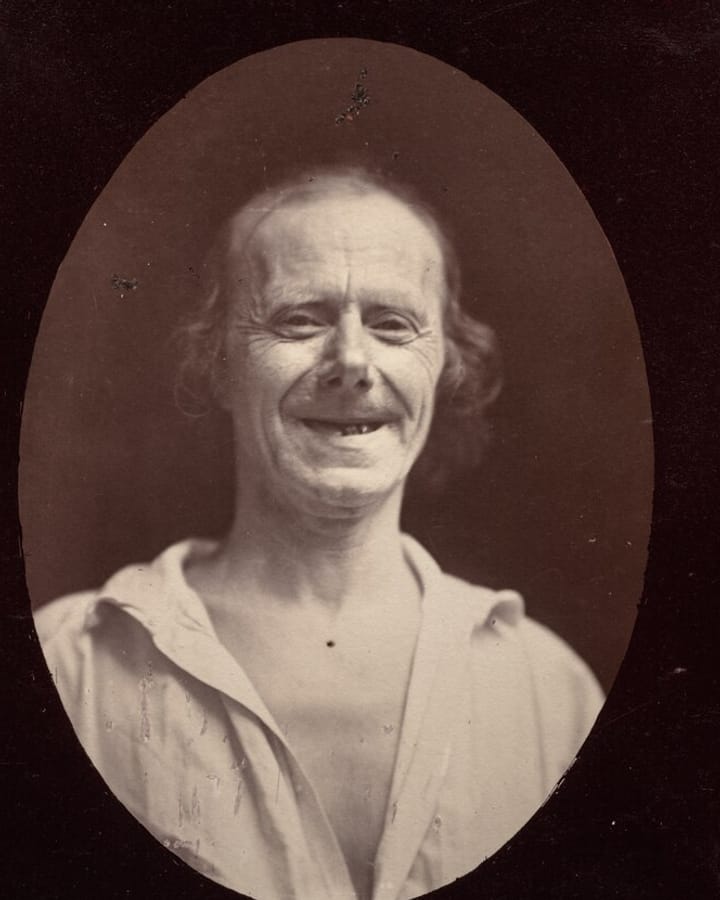
The photograph above shows a spontaneous laugh. In a genuine smile, the muscles around the eyes join the smile, not only the mouth. Smiles that included the eye muscles went with more reported enjoyment, and with a different pattern of brain electrical activity, than smiles that did not (Ekman et al., 1990).
What does hiding a feeling do to the face, the body and a relationship?
When a feeling is held back, the face may become calm, but the rest of the system often keeps working.
The body reacts more, not less. In the film experiment, hiding the expression raised signs of sympathetic activity and left the felt disgust unchanged (Gross & Levenson, 1993). In a later study, hiding the expression did not reduce the felt emotion, while rethinking the situation did (Gross, 1998).
A calm report is not always a calm body. People with a “repressive” coping style, who report little anxiety but score high on defensiveness, showed as much or more physiological reaction to stress as people who reported high anxiety (Weinberger et al., 1979).
Feelings can leak. Early observations suggested that concealed feelings may leak through the face and body (Ekman & Friesen, 1969). In a later study, everyone who tried to mask an emotion showed at least one brief, inconsistent expression. However, very brief “micro-expressions” were rare, and observers were only slightly better than chance at detecting which expressions were false (Porter & ten Brinke, 2008).
Hiding a feeling also changes the person on the other side of the conversation.
Study
In two experiments, pairs of women who had not met before discussed an upsetting topic. In the first, one woman in each pair was randomly asked to hide her emotional behaviour, to respond naturally, or to rethink the topic in a way that reduced her emotional response. Only hiding disrupted the conversation, and it raised the blood pressure responses of the partner. In the second, hiding also worsened the emotional experience of the woman who did it, raised blood pressure in both women, reduced rapport and made it harder for a relationship to form (Butler et al., 2003).
The women were strangers, not partners, so the findings cannot be applied directly to couples. They do suggest that a fixed smile is not a neutral act.
Further reading: Mindful Communication for Couples: Conflict Without Losing Closeness
Can defences change?
Defences are learned, so they can also shift.
Study
Twenty-one adults with depressive, anxiety or personality disorders had long-term psychodynamic psychotherapy, on average for 248 weeks, and were followed for about five years. Raters scored their defences from a sample of therapy sessions. Overall defensive functioning improved, including at the least and the most adaptive levels, although it remained below the range typical of healthy adults. The more defences had improved by two and a half years, the more functioning and symptoms had improved at five years (Perry & Bond, 2012).
Change in defences went together with lasting change in everyday functioning and symptoms. The study was small, and it describes one form of therapy, so it shows what is possible rather than what everyone should expect.
The article on forgiveness and acceptance and commitment therapy looks at one place where this matters: making room for hurt and anger instead of suppressing them.
What can this research not tell us?
Much of this research uses short laboratory tasks, often with small samples. Conscious emotion regulation is not the same thing as unconscious defence.
Brain findings describe patterns across groups, not a map of one person’s inner life.
No one can reliably read hidden feelings from someone’s face. Treating facial clues as proof is more likely to lead to mistakes than to understanding (Porter & ten Brinke, 2008).
Try it: expressive writing
If holding a feeling back keeps the body working, putting it into words is one tested alternative. In the expressive writing studies, people wrote about their thoughts and feelings about an important emotional experience, usually for 15 to 20 minutes on 3 to 5 occasions (Baikie & Wilhelm, 2005; Pennebaker, 1997).
Across 146 randomised studies, writing of this kind had a positive but small average effect (Frattaroli, 2006). Releasing held-back feelings may play a part, but changes in how people thought and used language as they wrote predicted better health (Pennebaker, 1997).
Exercise
- Choose an experience. Pick a stressful or emotional event that still affects you.
- Set a time. Write for 15 to 20 minutes, on 3 to 5 occasions, for example on consecutive days.
- Write about thoughts and feelings, not only facts. Describe what happened and your thoughts and feelings about it, then and now.
(Procedure from the expressive writing paradigm, as summarised by Pennebaker, 1997, and Baikie & Wilhelm, 2005.)
If the writing leaves you overwhelmed, or the experience involved trauma that still feels raw, stop and work through it with a professional instead.
Two questions to reflect on:
- When does your face say one thing while your body says another?
- Which of your defences, such as humour or setting a worry aside, feels chosen, and which feels automatic?
Common questions
Are defence mechanisms bad?
No. They protect us, and some, such as humour and anticipation, are linked with good adjustment (Vaillant, 1994). Problems arise when one defence is used rigidly, in every situation, and at a high cost.
Is it ever a good idea to set a feeling aside?
Yes. Consciously deciding to set a worry aside until a better moment is one of the more adaptive defences (Vaillant, 1994). This is different from keeping a straight face while the feeling is at its height, which leaves the felt emotion unchanged (Gross & Levenson, 1993).
Can you tell from someone’s face that they are hiding a feeling?
Not reliably. Concealed feelings can leak briefly, but untrained observers perform only slightly above chance (Porter & ten Brinke, 2008). Asking gently is more useful than guessing.
References
- Anderson, M. C., Ochsner, K. N., Kuhl, B., Cooper, J., Robertson, E., Gabrieli, S. W., Glover, G. H., & Gabrieli, J. D. E. (2004). Neural systems underlying the suppression of unwanted memories. Science, 303(5655), 232-235. https://doi.org/10.1126/science.1089504
- Baikie, K. A., & Wilhelm, K. (2005). Emotional and physical health benefits of expressive writing. Advances in Psychiatric Treatment, 11(5), 338-346. https://doi.org/10.1192/apt.11.5.338
- Butler, E. A., Egloff, B., Wilhelm, F. H., Smith, N. C., Erickson, E. A., & Gross, J. J. (2003). The social consequences of expressive suppression. Emotion, 3(1), 48-67. https://doi.org/10.1037/1528-3542.3.1.48
- Cramer, P. (2000). Defense mechanisms in psychology today: Further processes for adaptation. American Psychologist, 55(6), 637-646. https://doi.org/10.1037/0003-066X.55.6.637
- Dimberg, U., Thunberg, M., & Elmehed, K. (2000). Unconscious facial reactions to emotional facial expressions. Psychological Science, 11(1), 86-89. https://doi.org/10.1111/1467-9280.00221
- Ekman, P., Davidson, R. J., & Friesen, W. V. (1990). The Duchenne smile: Emotional expression and brain physiology II. Journal of Personality and Social Psychology, 58(2), 342-353. https://doi.org/10.1037/0022-3514.58.2.342
- Ekman, P., & Friesen, W. V. (1969). Nonverbal leakage and clues to deception. Psychiatry, 32(1), 88-106. https://doi.org/10.1080/00332747.1969.11023575
- Frattaroli, J. (2006). Experimental disclosure and its moderators: A meta-analysis. Psychological Bulletin, 132(6), 823-865. https://doi.org/10.1037/0033-2909.132.6.823
- Goldin, P. R., McRae, K., Ramel, W., & Gross, J. J. (2008). The neural bases of emotion regulation: Reappraisal and suppression of negative emotion. Biological Psychiatry, 63(6), 577-586. https://doi.org/10.1016/j.biopsych.2007.05.031
- Gross, J. J. (1998). Antecedent- and response-focused emotion regulation: Divergent consequences for experience, expression, and physiology. Journal of Personality and Social Psychology, 74(1), 224-237. https://doi.org/10.1037/0022-3514.74.1.224
- Gross, J. J., & Levenson, R. W. (1993). Emotional suppression: Physiology, self-report, and expressive behavior. Journal of Personality and Social Psychology, 64(6), 970-986. https://doi.org/10.1037/0022-3514.64.6.970
- Northoff, G., Bermpohl, F., Schoeneich, F., & Boeker, H. (2007). How does our brain constitute defense mechanisms? First-person neuroscience and psychoanalysis. Psychotherapy and Psychosomatics, 76(3), 141-153. https://doi.org/10.1159/000099841
- Ochsner, K. N., Silvers, J. A., & Buhle, J. T. (2012). Functional imaging studies of emotion regulation: A synthetic review and evolving model of the cognitive control of emotion. Annals of the New York Academy of Sciences, 1251(1), E1-E24. https://doi.org/10.1111/j.1749-6632.2012.06751.x
- Pennebaker, J. W. (1997). Writing about emotional experiences as a therapeutic process. Psychological Science, 8(3), 162-166. https://doi.org/10.1111/j.1467-9280.1997.tb00403.x
- Perry, J. C., & Bond, M. (2012). Change in defense mechanisms during long-term dynamic psychotherapy and five-year outcome. American Journal of Psychiatry, 169(9), 916-925. https://doi.org/10.1176/appi.ajp.2012.11091403
- Porter, S., & ten Brinke, L. (2008). Reading between the lies: Identifying concealed and falsified emotions in universal facial expressions. Psychological Science, 19(5), 508-514. https://doi.org/10.1111/j.1467-9280.2008.02116.x
- Rinn, W. E. (1984). The neuropsychology of facial expression: A review of the neurological and psychological mechanisms for producing facial expressions. Psychological Bulletin, 95(1), 52-77. https://doi.org/10.1037/0033-2909.95.1.52
- Vaillant, G. E. (1994). Ego mechanisms of defense and personality psychopathology. Journal of Abnormal Psychology, 103(1), 44-50. https://doi.org/10.1037/0021-843X.103.1.44
- Weinberger, D. A., Schwartz, G. E., & Davidson, R. J. (1979). Low-anxious, high-anxious, and repressive coping styles: Psychometric patterns and behavioral and physiological responses to stress. Journal of Abnormal Psychology, 88(4), 369-380. https://doi.org/10.1037/0021-843X.88.4.369
- Whalen, P. J., Rauch, S. L., Etcoff, N. L., McInerney, S. C., Lee, M. B., & Jenike, M. A. (1998). Masked presentations of emotional facial expressions modulate amygdala activity without explicit knowledge. The Journal of Neuroscience, 18(1), 411-418. https://doi.org/10.1523/JNEUROSCI.18-01-00411.1998