Can the first three minutes of an argument say something about a marriage’s future?
In one study, 124 newlywed couples each held a 15-minute discussion about a conflict in their marriage. Researchers coded the positive and negative emotions each partner expressed. Using only the first three minutes, they could predict which couples would divorce over the next six years (Carrère & Gottman, 1999).
How a disagreement begins matters.
This article looks at what conflict does to closeness, what mindfulness may add, what the research cannot yet show, and a short writing exercise that was tested with married couples.
What does conflict do to closeness?
Intimacy is more than romance. Researchers describe it as a process that unfolds in ordinary conversations.
Definition
In the interpersonal process model of intimacy, closeness grows when one person shares something personal and the other responds. In two diary studies of everyday social interactions, people felt more intimacy when both they and the other person disclosed, partly because they saw the other person as responsive. Disclosing emotions mattered more than disclosing facts and information (Laurenceau et al., 1998).
A disagreement is often such a moment. One partner shares something that matters to them and waits to see how the other responds.
Marital quality tends to decline over time. In one trial, reducing how distressed spouses felt about their conflicts helped to stop that decline (Finkel et al., 2013). The practice section below describes how.
Hurts left over from earlier conflicts are part of the picture too.
Further reading: Forgiveness and ACT: Letting Go Without Pretending It Was Fine
What is mindfulness, and how might it help partners?
Definition
Mindfulness means paying conscious and non-judgmental attention to present-moment experiences. It has two components: focused attention to bodily states, thoughts and emotions as they happen, and an open, accepting attitude towards them, whether they are pleasant or not (Karremans et al., 2017).
Its opposite is a mindless state: being lost in thought and acting on “automatic pilot” (Karremans et al., 2017).
Karremans and colleagues (2017) proposed a model of how mindfulness may support romantic relationships. Partners may notice automatic impulses, such as an urge to retaliate, at an earlier stage. They may regulate those impulses more easily, and make more room for the other person’s perspective.
Noticing an impulse may break the direct link between the impulse and what we do next (Karremans et al., 2017).
Example
Karremans and colleagues (2017) describe a husband who picks on his wife without realising that worries about his job are colouring his responses. Stress from outside the relationship can spill into it automatically, outside awareness. To keep it from shaping how we treat a partner, the authors argue, we first need to notice it, instead of avoiding it.
Mindfulness does not stop difficult emotions from arising. A mindful person recognises an emotion without identifying too much with it and without getting caught up in further thoughts and feelings (Karremans et al., 2017).
Emotion skills seem to be part of the story. In a study of married couples, mindfulness was related to marital quality, and this link ran fully through emotion skills: identifying and communicating emotions, and regulating the expression of anger (Wachs & Cordova, 2007).
What happens when mindful partners disagree?
Study
In a longitudinal study, people higher in trait mindfulness reported more relationship satisfaction and a greater capacity to respond constructively to relationship stress. In a second study, couples discussed a conflict in their relationship. Partners higher in trait mindfulness showed lower emotional stress responses and a more positive change in how they saw the relationship from before to after the discussion. Being more mindful during the discussion itself went with better communication quality (Barnes et al., 2007).
Researchers have also begun to study interpersonal mindfulness, meaning mindful attention during interactions with other people.
Dr. Soolmaz Dehghani was first and corresponding author of a 2025 study in Brain and Behavior that examined interpersonal mindfulness as a moderator in the relationship between marital conflict and marital intimacy among married individuals in Iran (Dehghanidowlatabadi et al., 2025). See the publications page.
What can mindfulness not do?
Strong claims have been made about mindfulness and relationships. Karremans and colleagues (2017) concluded that much of the support for their model is indirect, and that more research is needed before strong conclusions can be drawn.
Some studies, such as Wachs and Cordova (2007), measured mindfulness and relationship quality at the same time. Such studies show that the two go together, not that one causes the other.
The same authors also raise a possible downside that has not yet been tested. Some automatic processes help relationships, such as positive feelings towards a partner, and mindfulness might sometimes interfere with them (Karremans et al., 2017).
Mindfulness changes how we meet difficult feelings. It does not make them disappear.
If there is violence, threats or fear in your relationship, communication exercises are not the place to start. Seek specialised support first.
Try it: the neutral-observer writing exercise
Finkel and colleagues (2013) followed 120 married couples for two years. Every four months, spouses rated their satisfaction, love, intimacy, trust, passion and commitment, and wrote about their most significant recent disagreement.
In the second year, half of the couples were randomly assigned to a 7-minute writing task, three times, four months apart: 21 minutes in all. Both groups declined in marital quality in the first year. In the second year the decline continued in the comparison group but was eliminated in the writing group, and this effect ran through lower distress about their conflicts (Finkel et al., 2013).
Exercise
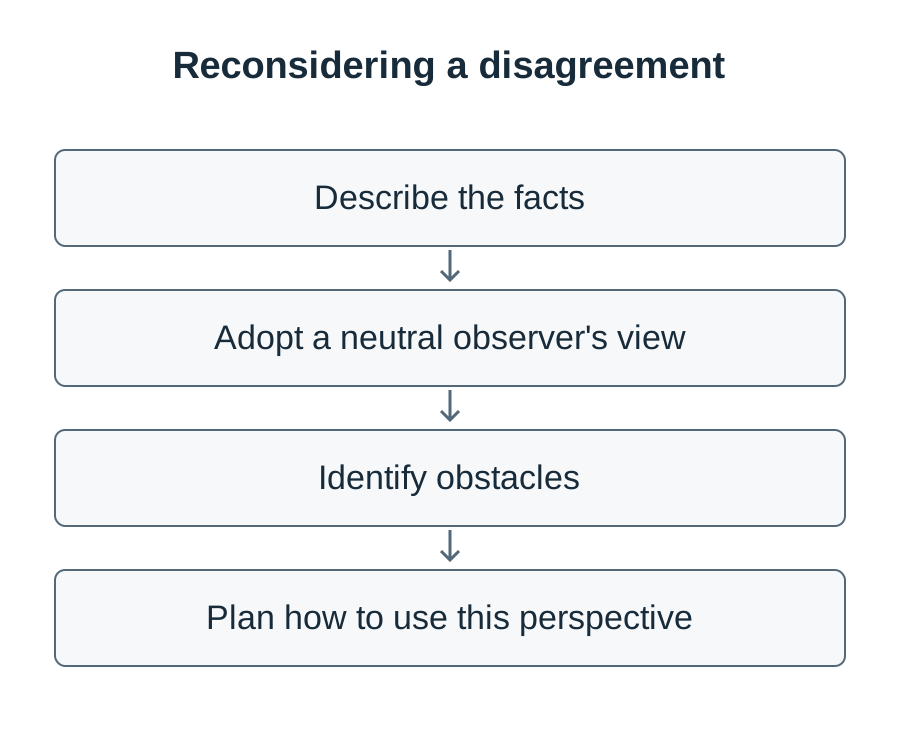
- Describe the disagreement. Write a short, fact-based summary of the most significant disagreement you have had with your partner recently, focusing on behaviour, not on thoughts or feelings.
- Take a neutral view. Think about this disagreement from the perspective of a neutral third party who wants the best for all involved. How might this person think about it? How might they find the good that could come from it?
- Name the obstacles. Almost everyone finds this perspective hard to keep at all times. What obstacles do you face in taking it, especially during a disagreement with your partner?
- Plan ahead. Over the next four months, how might you best take this perspective in your interactions with your partner, and how might it help you make the best of disagreements?
In the study, participants spent 7 minutes on steps 2 to 4 and repeated them every four months, with an email reminder in between. (Prompts adapted from Finkel et al., 2013.)
The authors suggest the task works partly by creating a self-distanced view of the conflict, together with the frame of wanting the best for everyone involved (Finkel et al., 2013). Strictly speaking, it is a reappraisal technique rather than a mindfulness practice (Finkel et al., 2013; Karremans et al., 2017).
The intervention preserved marital quality but did not increase it, and its effect did not depend on how long couples had been married. The authors note that for couples who are already distressed, preserving current quality may not be enough (Finkel et al., 2013).
Two questions to reflect on:
- When you look at your last disagreement as a neutral observer would, what do you notice that you missed in the moment?
- What usually makes it hardest for you to step back during a disagreement?
Common questions
Does frequent arguing mean a relationship is failing?
Not necessarily. In the studies described here, what predicted outcomes was how conflict was handled: the emotions partners expressed as a discussion began (Carrère & Gottman, 1999), and how much distress they carried from their conflicts (Finkel et al., 2013).
Does the exercise work if only one partner does it?
We do not know yet. In the trial, both spouses took part, and the authors list this as an open question (Finkel et al., 2013).
When is couples counselling worth considering?
If the same conflicts keep repeating, or one partner feels unheard, couples counselling can offer a structured space to change the pattern. If there is violence or fear in the relationship, seek specialised support first.
References
- Barnes, S., Brown, K. W., Krusemark, E., Campbell, W. K., & Rogge, R. D. (2007). The role of mindfulness in romantic relationship satisfaction and responses to relationship stress. Journal of Marital and Family Therapy, 33(4), 482-500. https://doi.org/10.1111/j.1752-0606.2007.00033.x
- Carrère, S., & Gottman, J. M. (1999). Predicting divorce among newlyweds from the first three minutes of a marital conflict discussion. Family Process, 38(3), 293-301. https://doi.org/10.1111/j.1545-5300.1999.00293.x
- Dehghanidowlatabadi, S., Pallathadka, H., Ismail, S. M., Abdullaev, D., Ibrahim, F. M., & Prasad, K. D. V. (2025). Moderating effect of interpersonal mindfulness between marital conflict and marital intimacy among Iranian married individuals. Brain and Behavior, 15(3), e70392. https://doi.org/10.1002/brb3.70392
- Finkel, E. J., Slotter, E. B., Luchies, L. B., Walton, G. M., & Gross, J. J. (2013). A brief intervention to promote conflict reappraisal preserves marital quality over time. Psychological Science, 24(8), 1595-1601. https://doi.org/10.1177/0956797612474938
- Karremans, J. C., Schellekens, M. P. J., & Kappen, G. (2017). Bridging the sciences of mindfulness and romantic relationships: A theoretical model and research agenda. Personality and Social Psychology Review, 21(1), 29-49. https://doi.org/10.1177/1088868315615450
- Laurenceau, J.-P., Barrett, L. F., & Pietromonaco, P. R. (1998). Intimacy as an interpersonal process: The importance of self-disclosure, partner disclosure, and perceived partner responsiveness in interpersonal exchanges. Journal of Personality and Social Psychology, 74(5), 1238-1251. https://doi.org/10.1037/0022-3514.74.5.1238
- Wachs, K., & Cordova, J. V. (2007). Mindful relating: Exploring mindfulness and emotion repertoires in intimate relationships. Journal of Marital and Family Therapy, 33(4), 464-481. https://doi.org/10.1111/j.1752-0606.2007.00032.x