In a 2025 trial, 65 nursing students were assigned to ACT group therapy or a control group. Academic procrastination improved with treatment, but the between-group difference in maladaptive perfectionism was not statistically significant (Ghasempour et al., 2025).
That distinction matters: improvement in starting and completing tasks need not mean every harsh personal standard has disappeared. This is an interpretation of the pattern, not proof of how the treatment worked.
This article considers the feelings behind delay, the limits of the new evidence, and a small way to practise starting.
What makes a delay worth examining?
Before calling a delay procrastination, consider whether you have consciously changed priorities or are repeatedly escaping a task you still intend to do. This is a useful question for reflection, not a diagnostic test.
Definition
In the CCI workbook’s formulation, procrastination can be maintained by immediate relief from task-related discomfort, even while unfinished work creates later difficulties (Saulsman & Nathan, 2008a).
Fear of failure is one possible starting point. Boredom, uncertainty and low confidence are other possibilities discussed in the workbook; it does not treat every delay as perfectionism (Saulsman & Nathan, 2008a).
Ask what the postponement is doing for you right now. Is it changing a realistic plan, or briefly removing a feeling you do not want to face? The workbook uses this short-term relief and longer-term cost distinction to help readers understand their own pattern (Saulsman & Nathan, 2008a).
Do I have to feel ready before I act?
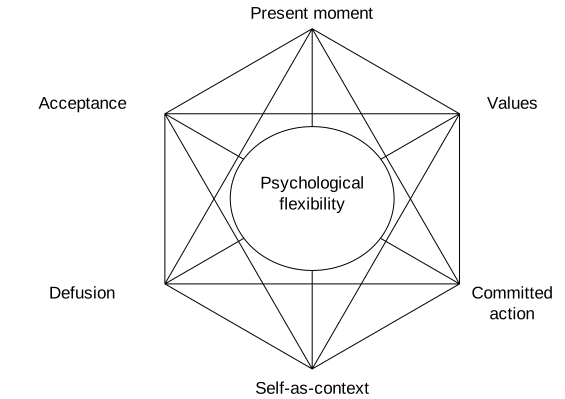

ACT describes psychological flexibility as making contact with present experience while taking action guided by personal values. Acceptance concerns willingness to experience difficult thoughts and feelings; it is not a requirement to approve of them (Hayes et al., 2006).
Applied to this question, the aim is to make room for discomfort while choosing a manageable action. Readiness can be something you practise acting without. This is an application of the ACT framework, not a promise that every task will become easy.
Further reading: Psychological Flexibility: What It Is and How to Build It
How strong is the recent evidence?
Study
The nursing-student trial used eight group sessions and assessed participants after treatment and eight weeks later. Its findings support further use and investigation of ACT for academic procrastination, but do not establish that all forms of perfectionism improve (Ghasempour et al., 2025).
A 2025 systematic review included nine empirical studies and judged ACT promising for academic procrastination, while calling for more rigorous randomised trials (Lee et al., 2025). Student samples do not tell us how much benefit every working adult should expect.
The exercise below comes from a CBT workbook, not from the ACT trial. Its inclusion is practical guidance from a published manual; the trial did not test this exercise on its own.
What does making a task smaller look like?
Example
The CCI workbook breaks paying a gas bill into locating the account and then contacting the company to pay. This is a published example of separating a task into actions, not a client story (Saulsman & Nathan, 2008b, p. 3).
Use the example to inspect your own task description: does it identify an action you can begin, or only the finished outcome?
When is a starting technique not enough?
CCI cautions that persistent underlying rules and difficulty tolerating discomfort may need more intensive professional help (Saulsman & Nathan, 2008c). If repeated delay is seriously disrupting your studies, work or essential care, discuss the pattern with a qualified professional.
Do not use a productivity exercise to override illness, a need for rest or an unsafe demand. First establish whether the task and its deadline are appropriate for your situation.
Try it: a five-minute beginning
Exercise
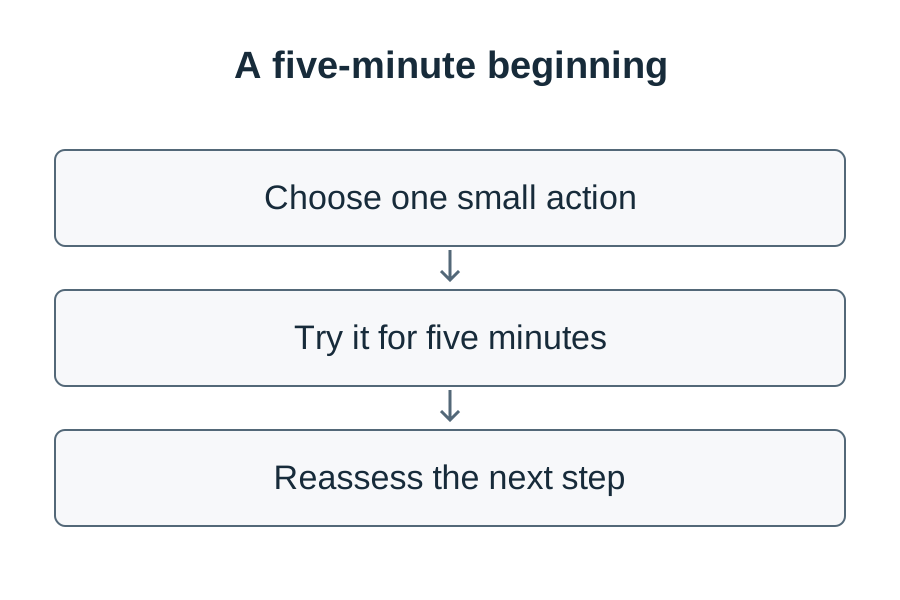
Briefly paraphrased from CCI’s task-grading and five-minute strategies:
- Select a postponed task and identify its first small action.
- Work on that action for five minutes.
- At the end, decide whether another short period is manageable.
Source: Saulsman and Nathan (2008b, pp. 2-4). This is a starting aid, not a complete treatment.
For reflection, CCI’s next module suggests examining whether an underlying rule is realistic and helpful, then considering a more flexible alternative (Saulsman & Nathan, 2008c). Which rule was present when you started? What would acting on a more helpful rule involve?
Common questions
Does procrastination always mean perfectionism?
No. The CCI formulation includes several possible sources of discomfort, including boredom and uncertainty (Saulsman & Nathan, 2008a). Explore your own pattern rather than assuming one explanation.
Did the ACT study prove that five minutes is enough?
No. It tested eight therapy sessions (Ghasempour et al., 2025). The five-minute approach is a separate workbook strategy (Saulsman & Nathan, 2008b).
What if I start but still feel anxious?
In ACT, useful action does not require the absence of uncomfortable feelings (Hayes et al., 2006). If distress becomes overwhelming, stop the exercise and seek individual support.
References
- Ghasempour, S., Bazghaleh, M., Basirinezhad, M. H., Setousar, M., Sadi, M., Mahmoodi, M., & Abbasi, A. (2025). Effectiveness of group therapy based on acceptance and commitment for nursing students’ procrastination and perfectionism: A parallel randomized controlled trial. Nurse Education in Practice, 84, 104301. https://doi.org/10.1016/j.nepr.2025.104301
- Hayes, S. C., Luoma, J. B., Bond, F. W., Masuda, A., & Lillis, J. (2006). Acceptance and commitment therapy: Model, processes and outcomes. Behaviour Research and Therapy, 44(1), 1-25. https://doi.org/10.1016/j.brat.2005.06.006
- Lee, S. H., Othman, A., & Ramlee, F. (2025). A systematic review on the effectiveness of acceptance and commitment therapy on academic procrastination. Discover Psychology, 5, Article 59. https://doi.org/10.1007/s44202-025-00379-8
- Saulsman, L., & Nathan, P. (2008a). Put off procrastinating: Module 2. Understanding procrastination, Part II. Centre for Clinical Interventions. Workbook module.
- Saulsman, L., & Nathan, P. (2008b). Put off procrastinating: Module 5. Practical techniques to stop procrastination. Centre for Clinical Interventions. Workbook module.
- Saulsman, L., & Nathan, P. (2008c). Put off procrastinating: Module 6. Adjusting unhelpful rules/assumptions and tolerating discomfort. Centre for Clinical Interventions. Workbook module.