Are young people more perfectionistic than a generation ago?
A meta-analysis pooled 164 samples of 41,641 college students in the United States, Canada and the United Kingdom who completed the same perfectionism questionnaire between 1989 and 2016. All three forms of perfectionism it measures rose over that time, and the largest rise was in socially prescribed perfectionism: the sense that others expect you to be perfect (Curran & Hill, 2019).
The fastest-rising form was the belief that others demand perfection of us.
Appearance is one place where that pressure is easy to see. This article looks at what perfectionism is, how it can turn towards the face and body, what research shows about edited images, and one tested way to answer a harsh inner critic.
What is perfectionism, and when is high striving healthy?
High standards are not a problem in themselves. Wanting to do good work or to present yourself well is part of ordinary life.
Hewitt and Flett (1991) described three forms of perfectionism: self-oriented perfectionism (demanding perfection of yourself), socially prescribed perfectionism (believing others demand it of you) and other-oriented perfectionism (demanding it of others).
Researchers also distinguish two broad dimensions (Stoeber & Otto, 2006). Perfectionistic strivings are the high personal standards and the drive to reach them. Perfectionistic concerns are the worry about mistakes, the harsh self-evaluation and the fear of others’ judgement.
Striving tends to go with positive characteristics, as long as it does not come with heavy concern about mistakes and other people’s evaluations (Stoeber & Otto, 2006).
What happens when perfectionism turns to appearance?
Perfectionism can differ from one area of life to another, and appearance is one of those areas (Yang & Stoeber, 2012).
Definition
Physical appearance perfectionism has two sides: a hope for a perfect appearance and a worry about looking imperfect. In a series of studies with 2,316 students, the worry side went with lower appearance self-esteem and more body image disturbance, while the hope side went with positive striving and impression management (Yang & Stoeber, 2012). Social appearance anxiety is anxiety about being negatively evaluated by others because of your overall appearance, including body shape (Hart et al., 2008).
Dr. Soolmaz Dehghani co-authored a longitudinal study, published in 2026 in The Journal of Genetic Psychology, that examined the pathway from body appearance perfectionism to social appearance anxiety, including the roles of digital filter use and fear of missing out (Abdollahi et al., 2026). See the publications page.
Do edited photos and filters raise the bar?
Edited images can make an impossible standard look normal. Two experiments show how.
Study
In an experiment, 144 girls aged 14 to 18 were randomly shown either original Instagram selfies or the same selfies retouched and reshaped. Girls who saw the manipulated photos reported a lower body image, especially those who tended to compare themselves with others. They rated the manipulated photos more positively than the originals. They noticed filters and effects, but not the reshaping of the bodies, and girls in both groups found the pictures realistic (Kleemans et al., 2018).
The girls noticed the filters, but not the reshaped bodies.
Natural images may help in the other direction.
Study
In another experiment, 305 women aged 18 to 30 were randomly assigned to view one of three sets of Instagram images: “Instagram vs reality” posts that place an idealised and a more natural photo of the same woman side by side, the idealised side alone, or the natural side alone. Women who saw the side-by-side or the natural images reported less body dissatisfaction than those who saw only the idealised images, and comparing themselves with the images did them less harm (Tiggemann & Anderberg, 2020). The authors note that longer-term effects still need to be studied.
Both studies measured effects over a single session, so they show what edited images can do in the moment, not what they do over years.
When is perfectionism a reason to seek help?
Perfectionism is more than a personal style. A meta-analysis of 284 studies found that both perfectionistic strivings and perfectionistic concerns were associated with various forms of psychological difficulty. The outcomes it examined included depression, anxiety disorders, obsessive-compulsive disorder, eating disorders, self-harm and suicidal ideation (Limburg et al., 2017).
Help exists. A meta-analysis of 15 randomised controlled trials, with 912 participants, found that cognitive behaviour therapy for perfectionism, delivered face to face or as self-help, reduced perfectionism and symptoms of depression, anxiety and eating disorders (Galloway et al., 2022). The trials were few, and they did not compare this therapy with other active treatments.
If worries about how you look take up much of your day, keep you away from people, or come with restricted eating or low mood, talk with a professional.
Can kindness towards yourself soften a harsh standard?
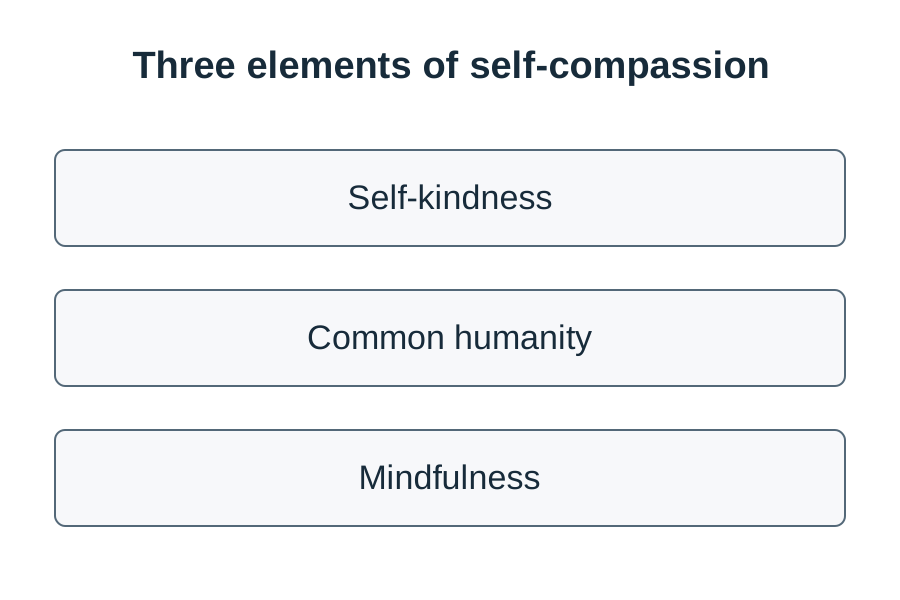
Self-compassion has three components (Neff, 2003): self-kindness, meaning being kind and understanding towards yourself in pain or failure instead of harshly self-critical; common humanity, meaning seeing your experience as part of the larger human experience; and mindfulness, meaning holding painful thoughts and feelings in balanced awareness instead of over-identifying with them.
In one study, 96 female university students read a scenario designed to make them feel worse about their bodies and were then randomly assigned to a self-compassion, self-esteem or neutral writing task. The self-compassion group showed higher body appreciation than both other groups straight afterwards, and higher than the control group two weeks later. Both the self-compassion and self-esteem tasks improved body satisfaction compared with the control task, and the groups did not differ in appearance anxiety (Seekis et al., 2017).
Further reading: Forgiveness and Acceptance and Commitment Therapy: Letting Go Without Pretending It Was Fine
Try it: three minutes of self-compassionate writing
In a study by Moffitt and colleagues (2018), 153 participants first faced a threatening body image scenario. They were then randomly assigned to a self-esteem task, a self-compassion task or a positive distraction task. After the self-compassion task, weight and appearance dissatisfaction were lower, and motivation to improve was higher, than in both other groups. The benefit was clearest for people who were already more dissatisfied with their bodies.
Exercise
- Choose the moment. In the studies, the writing came straight after something that made participants feel worse about their bodies (Moffitt et al., 2018; Seekis et al., 2017). Use it after a moment like that.
- Set a timer for three minutes.
- Write a paragraph to yourself. Address yourself directly, and express kindness, compassion and understanding towards yourself about your weight, appearance and body shape.
- If you get stuck, use the three components of self-compassion. Be kind instead of harsh, remember that this struggle is part of the larger human experience, and name the painful feeling without letting it take over (Neff, 2003).
(Task from the self-compassion condition in Moffitt et al., 2018; the three components from Neff, 2003.)
These are short-term effects from single sessions, so the task is a way to recover from a difficult moment, not a treatment for long-standing distress.
Two questions to reflect on:
- Which images or situations most often leave you feeling that you must look flawless?
- How did your words to yourself in the exercise differ from the way you usually speak to yourself about your appearance?
Common questions
Is perfectionism always harmful?
Not always. High personal standards tend to go with positive characteristics when they do not come with heavy concern about mistakes and others’ judgement (Stoeber & Otto, 2006). Even so, both dimensions of perfectionism have been linked with psychological difficulties (Limburg et al., 2017).
Do filters cause appearance anxiety?
It would be too simple to say so. Experiments show that manipulated images can lower body image in the moment (Kleemans et al., 2018), but they did not follow people over time, and longer-term effects still need study (Tiggemann & Anderberg, 2020).
Won’t being kind to myself make me lazy?
The research points the other way. After a self-compassion writing task, participants reported more motivation to improve, not less, than after a self-esteem or distraction task (Moffitt et al., 2018).
References
- Abdollahi, A., Dehghanidowlatabadi, S., Jamaludin, A. N. S. J., & Tan, L. H. (2026). The longitudinal pathway from body appearance perfectionism to social appearance anxiety: The mediating role of digital filter use and moderating role of fear of missing out. The Journal of Genetic Psychology. https://doi.org/10.1080/00221325.2026.2680991
- Curran, T., & Hill, A. P. (2019). Perfectionism is increasing over time: A meta-analysis of birth cohort differences from 1989 to 2016. Psychological Bulletin, 145(4), 410-429. https://doi.org/10.1037/bul0000138
- Galloway, R., Watson, H., Greene, D., Shafran, R., & Egan, S. J. (2022). The efficacy of randomised controlled trials of cognitive behaviour therapy for perfectionism: A systematic review and meta-analysis. Cognitive Behaviour Therapy, 51(2), 170-184. https://doi.org/10.1080/16506073.2021.1952302
- Hart, T. A., Flora, D. B., Palyo, S. A., Fresco, D. M., Holle, C., & Heimberg, R. G. (2008). Development and examination of the Social Appearance Anxiety Scale. Assessment, 15(1), 48-59. https://doi.org/10.1177/1073191107306673
- Hewitt, P. L., & Flett, G. L. (1991). Perfectionism in the self and social contexts: Conceptualization, assessment, and association with psychopathology. Journal of Personality and Social Psychology, 60(3), 456-470. https://doi.org/10.1037/0022-3514.60.3.456
- Kleemans, M., Daalmans, S., Carbaat, I., & Anschütz, D. (2018). Picture perfect: The direct effect of manipulated Instagram photos on body image in adolescent girls. Media Psychology, 21(1), 93-110. https://doi.org/10.1080/15213269.2016.1257392
- Limburg, K., Watson, H. J., Hagger, M. S., & Egan, S. J. (2017). The relationship between perfectionism and psychopathology: A meta-analysis. Journal of Clinical Psychology, 73(10), 1301-1326. https://doi.org/10.1002/jclp.22435
- Moffitt, R. L., Neumann, D. L., & Williamson, S. P. (2018). Comparing the efficacy of a brief self-esteem and self-compassion intervention for state body dissatisfaction and self-improvement motivation. Body Image, 27, 67-76. https://doi.org/10.1016/j.bodyim.2018.08.008
- Neff, K. D. (2003). Self-compassion: An alternative conceptualization of a healthy attitude toward oneself. Self and Identity, 2(2), 85-101. https://doi.org/10.1080/15298860309032
- Seekis, V., Bradley, G. L., & Duffy, A. (2017). The effectiveness of self-compassion and self-esteem writing tasks in reducing body image concerns. Body Image, 23, 206-213. https://doi.org/10.1016/j.bodyim.2017.09.003
- Stoeber, J., & Otto, K. (2006). Positive conceptions of perfectionism: Approaches, evidence, challenges. Personality and Social Psychology Review, 10(4), 295-319. https://doi.org/10.1207/s15327957pspr1004_2
- Tiggemann, M., & Anderberg, I. (2020). Social media is not real: The effect of ‘Instagram vs reality’ images on women’s social comparison and body image. New Media & Society, 22(12), 2183-2199. https://doi.org/10.1177/1461444819888720
- Yang, H., & Stoeber, J. (2012). The Physical Appearance Perfectionism Scale: Development and preliminary validation. Journal of Psychopathology and Behavioral Assessment, 34(1), 69-83. https://doi.org/10.1007/s10862-011-9260-7