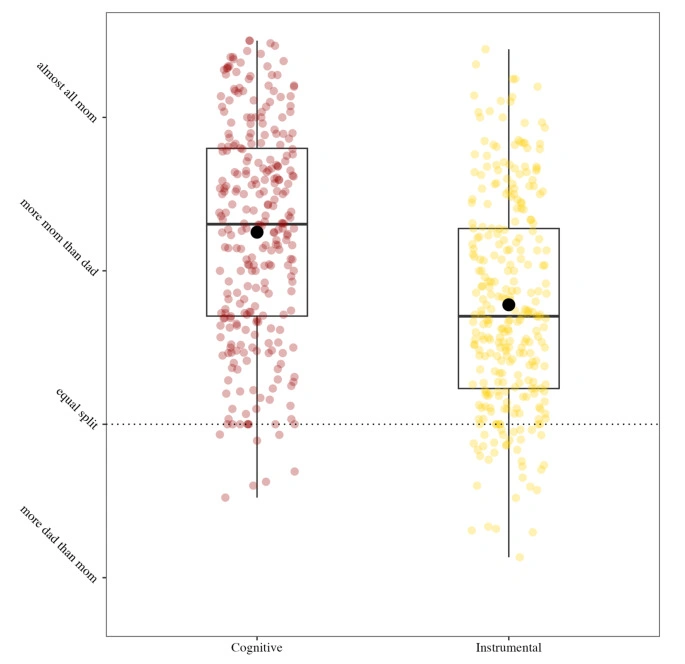
A study of 322 mothers asked separately about planning and carrying out 30 household tasks. Mothers reported a greater imbalance in the thinking behind the work than in its physical execution (Aviv et al., 2025).
Counting completed chores therefore leaves an important question open: who keeps track of what needs doing? The study first appeared online in 2024 and in a 2025 journal issue; a subsequent pilot intervention appeared in a 2026 issue.
This article explains the distinction, examines what the newer evidence supports, and introduces a published framework for discussing responsibility.
What is the mental load of running a home?
Definition
Daminger (2019) describes cognitive household labour as anticipating needs, identifying possible solutions, deciding among them, and monitoring outcomes. These activities are distinct from physically carrying out the task.
The definition grew from 70 interviews with members of 35 couples. Women did more anticipation and monitoring in this sample, while decision-making was more evenly shared (Daminger, 2019). This describes a pattern in a particular sample, not a rule about every woman or man.
For your own discussion, separate the question of who did the visible work from who managed it. Treat both as responsibilities worth naming.
What might go unnoticed in an ordinary task?
Example
In USC’s published project report, a mother described planning her children’s mental-health, physical-health and additional-needs care even when she was not the person taking them to appointments. This paraphrased participant account illustrates the difference between organising care and attending it (Aviv et al., 2024, p. 22).
Use the distinction to examine a responsibility in your household. If the visible action has been shared, has the work of keeping it organised also changed hands?
What do the recent studies actually show?
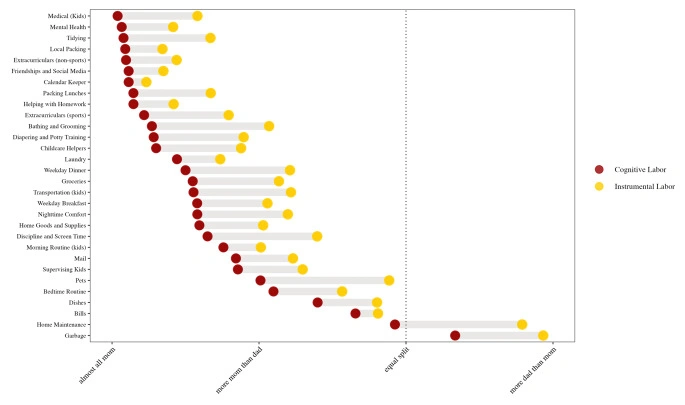
In the 322-mother study, a greater share of cognitive labour was associated with worse mental-health and relationship measures. The study relied on mothers’ self-reports and was cross-sectional: it cannot establish that unequal planning caused those difficulties (Aviv et al., 2025).
Study
A pilot study published in a 2026 issue tested an online Fair Play intervention with 87 US mothers; 54% completed it. More equal cognitive labour after participation was associated with better outcomes on several health measures. This was an open trial without a randomised control group, so its findings are preliminary (Aviv et al., 2026).
The pilot appeared online in October 2025. Neither study establishes how well the approach transfers to every culture or household structure. Promising evidence is a reason to investigate a method, not a guarantee that it will repair a relationship.
How is shared responsibility different from helping?
In Rodsky’s Fair Play framework, responsibility includes recognising a need, planning for it and carrying it through. Partners agree beforehand on what adequate completion involves, rather than leaving expectations unspoken (Rodsky, 2019).
The useful question is whether responsibility has actually moved, not just whether someone performed a requested action. This is a practical reading of the framework, not a clinical measure of relationship quality.
The USC report also records participants valuing a new vocabulary for discussing planning and execution (Aviv et al., 2024). Naming these components gives a conversation a more specific subject than deciding who is generally more caring.
Further reading: Mindful Communication for Couples
When is a household exercise not the right next step?
Use this discussion only if both people can participate freely. If disagreement involves threats, intimidation or control, seek confidential individual support rather than treating it as a task-allocation problem.
Do not use a chart to demand identical workloads despite illness, disability or other constraints. Establish what is feasible for your household. A method for discussing work does not itself supply missing time, income or support.
Try it: discuss responsibility from beginning to end
Exercise
A short application of Rodsky’s published Fair Play framework:
- Choose a household responsibility together.
- Identify who will recognise the need, plan and carry it out.
- Agree what adequate completion means before handing it over.
Source: Rodsky (2019), publisher’s discussion guide. This is an introduction to the framework, not the complete programme tested in the pilot.
To examine what happened, return to the planning/execution distinction used in the USC project (Aviv et al., 2024). Who carried the planning? Who carried out the task? Use your answers to discuss the arrangement, not to score each other’s character.
Common questions
Does fairness mean dividing every task in half?
The Fair Play framework assigns responsibility for a task across recognition, planning and execution (Rodsky, 2019). For this exercise, focus on an agreed arrangement that is workable for both people rather than halving each individual action.
Does mental load explain all relationship dissatisfaction?
No. The observational study found associations; it did not establish a single cause of relationship difficulty (Aviv et al., 2025).
Is Fair Play an established treatment for depression?
The cited pilot is too limited to establish that claim (Aviv et al., 2026). If low mood is persistent or disabling, seek an individual assessment alongside any discussion of household responsibilities.
References
- Aviv, L., Saxbe, D., Messer, D., & Rao, S. (2024). The Fair Play Method: Can we solve for the unequal division of domestic labor? Final report. USC Dornsife Public Exchange. Research report.
- Aviv, E., Waizman, Y., Kim, E., Liu, J., Rodsky, E., & Saxbe, D. (2025). Cognitive household labor: Gender disparities and consequences for maternal mental health and wellbeing. Archives of Women’s Mental Health, 28, 5-14. First published online in 2024. https://doi.org/10.1007/s00737-024-01490-w
- Aviv, E. C., Vavala, G., Lindquist, E. G., Waizman, Y. H., & Saxbe, D. E. (2026). Shifting the load: A pilot study of a behavioral intervention to reduce gender inequities in household labor and improve mental health outcomes. Behavior Therapy, 57(3), 563-576. First published online in 2025. https://doi.org/10.1016/j.beth.2025.10.002
- Daminger, A. (2019). The cognitive dimension of household labor. American Sociological Review, 84(4), 609-633. https://doi.org/10.1177/0003122419859007
- Rodsky, E. (2019). Fair play: A game-changing solution for when you have too much to do (and more life to live). G. P. Putnam’s Sons. Publisher’s discussion guide.