Can a single counselling session help after an unsuccessful IVF cycle? A 2025 randomised trial with 80 women found improvement in feeling informed about choices and in making sense of the experience, but no significant benefit on the overall decisional-conflict score (Guo et al., 2025).
This is a useful distinction: support may help with parts of a difficult decision without resolving all of it. The aim here is not to decide for you whether to continue treatment.
This article separates medical information, personal priorities and outside pressure, then introduces a published guide for preparing your next conversation.
Why does this decision involve more than the next treatment cycle?
A systematic review of 22 studies identified physical and psychological burden, alongside relational and personal problems, among reported reasons for discontinuing fertility treatment (Gameiro et al., 2012). Those findings describe patients’ reasons; they do not tell any individual what to choose.
Consider what kind of help you need. Questions about treatment options and the consequences of waiting belong with your fertility team. Questions about what you can bear, value or accept also deserve space in the conversation.
Definition
A decision guide helps organise the choice, available information, personal priorities and next steps. Ottawa’s guide is a general decision-support tool, not an IVF-specific source of medical advice (Ottawa Hospital Research Institute, n.d.).
What did the new counselling study show?
Study
The trial compared a one-hour individual session with a waiting-list group. Feeling informed and meaning-making improved; effects on total decisional conflict, depression and stress were not significant. The anxiety result also did not meet the conventional threshold for statistical significance (Guo et al., 2025).
The distinction between an overall score and one part of that score matters. This trial does not show that one session settles the decision or treats all distress after IVF. It offers limited evidence for specific aspects of support in one setting.
What might a supported conversation include?
Example
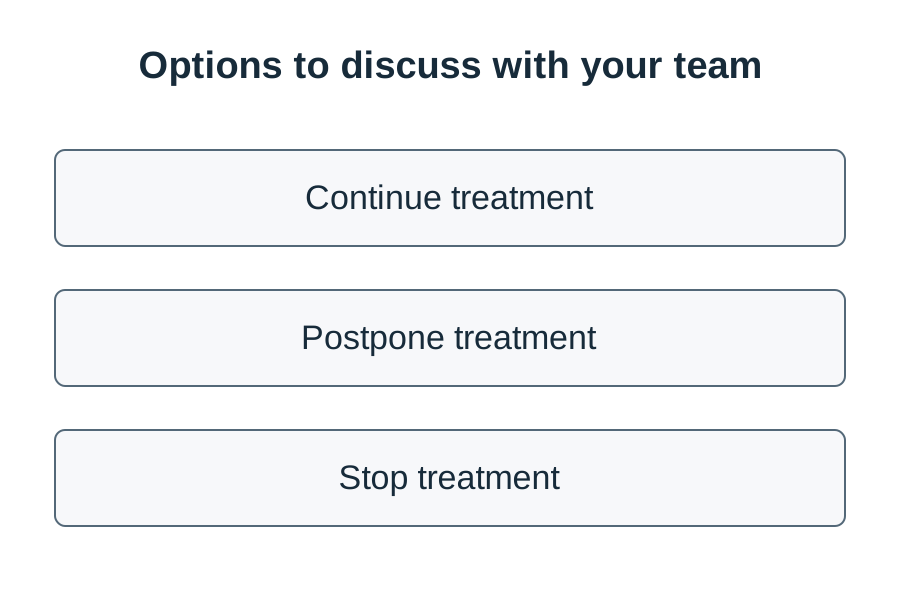
In the published intervention, the practitioner discussed continuing, postponing or stopping treatment, alongside other personally relevant possibilities. Each option was explored through its implications, challenges and available resources (Guo et al., 2025). This is a description of the study procedure, not a fictional patient story.
Do not assume that every option discussed in a study is available or suitable for you. Ask your own team to identify medically appropriate choices and whether a decision has a time limit.
ESHRE’s psychosocial-care guideline treats information needs, emotional needs and relationship needs as distinct parts of fertility care (Gameiro et al., 2015). You can bring more than one kind of question to the appointment; needing emotional support does not remove the need for clear medical information.
Further reading: Emotional Wellbeing During IVF
What if my partner and I are in different places?
The Ottawa Personal Decision Guide for Two gives each person space to indicate how far they have progressed towards a choice, what matters to them and which option they prefer. It also asks about pressure from other people (Stacey et al., 2025b).
Use that structure to make differences visible before trying to resolve them. A difference in information calls for checking facts; a difference in priorities calls for listening to what the other person values. The individual Ottawa guide explicitly distinguishes these two situations (Stacey et al., 2025a).
Agreement should not be obtained through coercion. If you cannot discuss treatment freely or safely, seek confidential individual support.
When is a self-help guide not enough?
This article cannot determine whether a pause is medically appropriate or predict the outcome of another cycle. Clarify those questions with your treating team before changing a treatment plan.
ESHRE recommends specialised psychosocial care for people experiencing, or at risk of, clinically significant psychosocial difficulties when unsuccessful treatment ends (Gameiro et al., 2015). If distress is severe or daily functioning is affected, ask for individual assessment rather than relying on a worksheet.
Try it: prepare with the Ottawa decision guide
Exercise
Open the original Ottawa Personal Decision Guide. Its four sections organise your decision, options, other people’s views and outstanding needs. Complete the original form and bring it to your appointment (Stacey et al., 2025a).
For a shared discussion, use the original guide for two, which has separate spaces for each person’s priorities (Stacey et al., 2025b).
These links lead to the English originals. The explanation here is not an authorised translation or a replacement form. If needed, ask your clinician to help you work through the original.
The guide is for identifying what still needs attention, not calculating a medically correct answer. An unfinished section can be useful material for the next appointment (Ottawa Hospital Research Institute, n.d.).
Common questions
Does considering a pause mean I have decided to stop?
The intervention treated postponing and stopping as separate possibilities (Guo et al., 2025). Ask your fertility team what each would mean in your circumstances before making a decision.
Should counselling persuade me to continue?
The decision-guide approach is organised around your information needs and priorities, including whether others are pressuring you (Stacey et al., 2025a). Use support to clarify your choice, not to fulfil someone else’s preferred outcome.
Can this guide tell me my chance of pregnancy?
No. It is a general guide for health and social decisions (Ottawa Hospital Research Institute, n.d.). Individual treatment estimates and their uncertainty need discussion with your fertility team.
References
- Gameiro, S., Boivin, J., Dancet, E., de Klerk, C., Emery, M., Lewis-Jones, C., Thorn, P., Van den Broeck, U., Venetis, C., Verhaak, C. M., Wischmann, T., & Vermeulen, N. (2015). ESHRE guideline: Routine psychosocial care in infertility and medically assisted reproduction: A guide for fertility staff. Human Reproduction, 30(11), 2476-2485. https://doi.org/10.1093/humrep/dev177
- Gameiro, S., Boivin, J., Peronace, L., & Verhaak, C. M. (2012). Why do patients discontinue fertility treatment? A systematic review of reasons and predictors of discontinuation in fertility treatment. Human Reproduction Update, 18(6), 652-669. https://doi.org/10.1093/humupd/dms031
- Guo, D.-Y., Chan, C. H.-Y., Leng, L.-L., Zhang, J.-H., Wang, X.-H., & Zhang, C.-X. (2025). Efficacy of a single-session intervention for women following unsuccessful in vitro fertilization treatment: A randomized controlled trial. Clinical Social Work Journal, 53, 423-438. https://doi.org/10.1007/s10615-025-00999-6
- Ottawa Hospital Research Institute. (n.d.). Decision guides. Retrieved October 17, 2026. Guide information and conditions of use.
- Stacey, D., Lewis, K., & O’Connor, A. (2025a). Ottawa Personal Decision Guide. Ottawa Hospital Research Institute and University of Ottawa. Original guide.
- Stacey, D., Lewis, K., & O’Connor, A. (2025b). Ottawa Personal Decision Guide for Two. Ottawa Hospital Research Institute and University of Ottawa. Original guide for two.