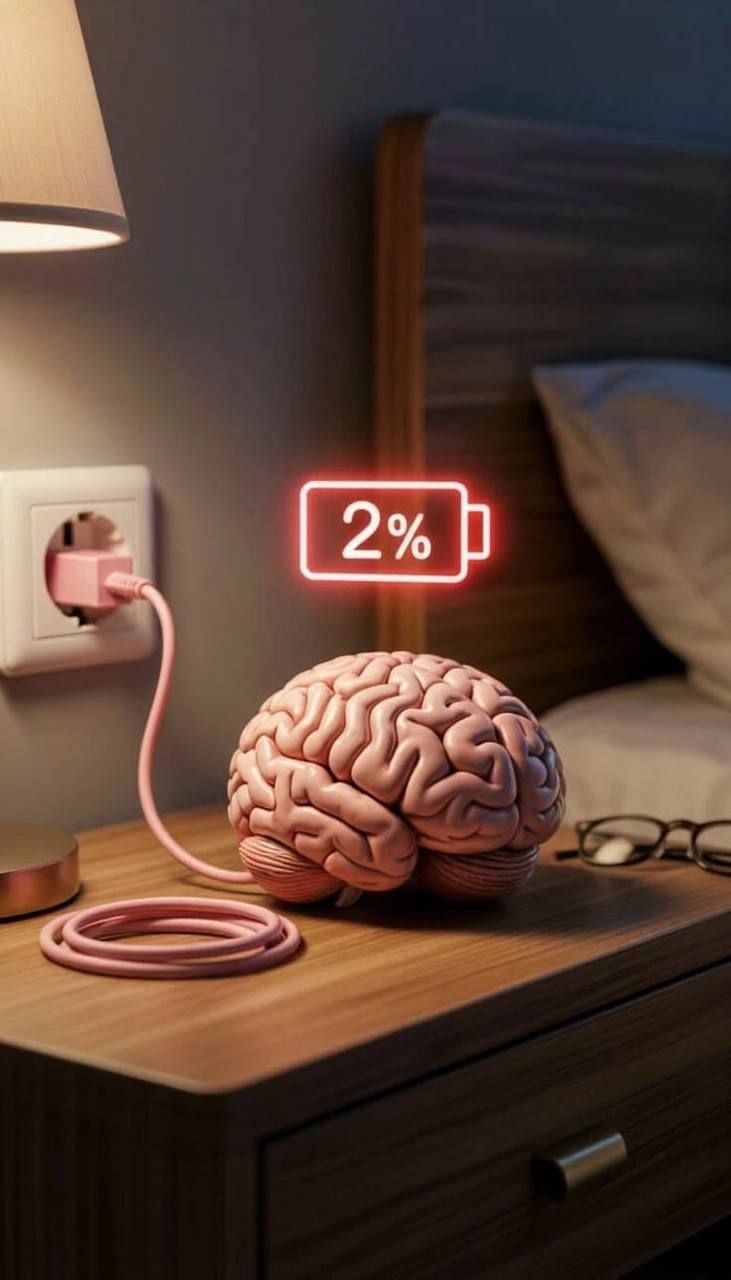
The hours of sleep look adequate on paper, yet we wake up with a heavy body and an empty mind. A 2026 narrative review on obstructive sleep apnea reminds us that fatigue, poor concentration and non-restorative sleep overlap with obesity, chronic pain, depression and inflammatory disease. That overlap makes the cause hard to identify (Tasneem et al., 2026).
“Mental energy leakage” is a popular phrase, not a medical or psychological diagnosis. Here we treat it as a description of fatigue that ordinary rest does not relieve.
This article explains how mental fatigue differs from sleepiness, which factors recent studies have linked to it, and which strategies have been examined. Most of the research used concerns specific groups, so its findings should not be applied directly to every reader.
What could “mental energy leakage” mean scientifically?
A 2026 narrative review on collegiate athletes does not treat mental fatigue as simple tiredness. It describes it as a cognitive, emotional and psychobiological outcome shaped by stress appraisal, attentional load, effort regulation and resource depletion (Gao et al., 2026).
Documented definition: mental fatigue
According to Gao et al. (2026), mental fatigue results from the interaction of how a person appraises stress, attentional strain and effort to regulate oneself, not simply from lack of sleep. The review is conceptual and focuses on collegiate athletes, so it offers a framework for thinking, not a diagnosis.
Put simply, a mind that is constantly monitoring, deciding or suppressing emotion may feel drained even without heavy physical activity. This fits the framework of the review above, but the review has not proven such a mechanism in the general public.
Why does enough sleep time not always mean restorative sleep?
The amount of sleep is not the same as its quality. In obstructive sleep apnea, repeated airway blockages cause intermittent drops in oxygen, brief awakenings and fragmented sleep. The review stresses that the condition is common and often goes undiagnosed (Tasneem et al., 2026).
In the same review, continuous positive airway pressure (CPAP) therapy has clearer benefits for breathing events, oxygenation, sleepiness and sleep-related quality of life. Its effect on fatigue and pain looks promising in selected groups but is not conclusive.
This does not mean everyone who is tired has sleep apnea. The review is narrative, and much of its evidence is observational or mechanistic. It only shows that sleep disorders are one cause of fatigue worth checking.
Stress, anxiety and recovery: does the mind really rest after work?
Two cross-sectional studies from 2026 examined psychological factors linked to fatigue. In both, recovery and mentally detaching from work play a role.
One study: anxiety, recovery and occupational fatigue
Ji et al. (2026) surveyed 311 meteorological exploration personnel. Higher anxiety sensitivity was associated with more occupational fatigue. Poorer recovery experience and lower confidence in regulating emotions explained part of that relationship. The design was cross-sectional and the group worked in high-risk conditions, so it cannot establish causal direction.
In another study of 340 nursing interns, perceived stress was the strongest predictor of self-regulatory fatigue (β = 0.47). Psychological detachment from work was associated with less fatigue (β = -0.10). Together the model explained 39.1 percent of the variance (Chang et al., 2026).
The cautious reading of these two studies is that high stress and insufficient recovery are associated with more fatigue. Both are cross-sectional and concern particular groups. Fatigue could also make recovery harder.
Why is one marker or one cause usually not enough?
A 2026 narrative review on fatigue in inflammatory rheumatic diseases shows that fatigue may continue even after inflammation improves. In that review, fatigue was more strongly associated with pain, sleep disturbance, mood symptoms, disability, central pain sensitivity, comorbidity, medication effects and reduced activity tolerance than with inflammatory markers (Gwóźdź-Broczkowska, 2026).
The author proposes a “treatable traits” framework: evaluate disease activity, fatigue severity, pain, sleep, mood, comorbidities, medications and deconditioning in sequence. This framework was proposed for rheumatology patients; for the general public it is a way of thinking, not a validated method.
What should we review before seeing a professional?
None of the sources I read gives a complete list of warning signs or a diagnostic pathway for fatigue in the general population. Still, the reviews above show that sleep, mood, pain, medication and comorbid conditions can all contribute to fatigue.

For a conversation with a doctor or mental health professional, it can help to write down a few points: when the fatigue began, how it relates to changes in sleep, pain, mood, medication or activity, and what makes it better or worse. This note is not a substitute for professional assessment.
Which strategies have been studied, and how confident can we be?
Most of the evidence below comes from patient groups, not from healthy people with unexplained fatigue.
- Assessing sleep disorders and accompanying causes. The reviews by Tasneem et al. (2026) and Gwóźdź-Broczkowska (2026) both emphasize evaluating sleep and related factors.
- Self-management education. In a 2026 meta-analysis of 30 studies in haemodialysis patients, self-management education reduced fatigue with a standardized effect size of 0.98 and moderate certainty (Zhang et al., 2026).
- Exercise. In the same meta-analysis, exercise training showed an effect size of 0.82 with low certainty. In a systematic review of 27 post-COVID trials, supervised cardiopulmonary rehabilitation and multimodal exercise improved cardiorespiratory fitness and walking capacity (Negm et al., 2026).
- Cognitive behavioural therapy (CBT). Results are mixed. In post-COVID condition, CBT and lifestyle adjustments reduced fatigue, but only 18.5 percent of trials had low risk of bias (Negm et al., 2026). In haemodialysis patients CBT had no significant effect and the certainty of evidence was very low (Zhang et al., 2026).
- Recovery and psychological detachment. These were reported only as cross-sectional associations (Ji et al., 2026; Chang et al., 2026); their effectiveness as interventions was not tested here.
None of this evidence shows that one particular method works for everyone with unexplained fatigue. The choice of path should rest on individual assessment and a professional’s decision.
Limitations and cautions
- Most sources concern specific patient or occupational groups.
- This article relies only on study abstracts and has not examined the full texts.
- Cross-sectional studies show associations, not causes.
- Persistent fatigue may signal a physical or psychological problem; this article cannot replace individual diagnosis or treatment.
Questions for reflection
- Is my fatigue mostly physical, mental, or both?
- At what times of the week is it worse or better?
- Has anything changed in my sleep, pain, mood, medication or workload at the same time?
Frequently asked questions
Does fatigue despite enough sleep mean I have depression or anxiety?
Not necessarily. Fatigue is linked to several factors, including sleep disorders, pain, medication and comorbid conditions. Only a professional assessment can establish a diagnosis.
Is “mental energy leakage” a diagnosis?
No. It is a popular descriptive phrase. Research uses concepts such as mental fatigue, self-regulatory fatigue or occupational fatigue instead.
Do exercise or CBT cure fatigue?
In certain patient groups there is some supportive evidence, but its quality and consistency vary. It cannot be generalized with certainty to everyone.
References
- Tasneem, S., Fernandes, W., Sulaiman, H., Aldhuaina, K. M., Fuqaha, F., Gianni, T., & Morani, Z. (2026). Obstructive sleep apnea as a modifiable contributor to chronic pain in rheumatologic disease: The potential role of continuous positive airway pressure therapy. Cureus. https://doi.org/10.7759/cureus.113582
- Gwóźdź-Broczkowska, A. (2026). Fatigue beyond inflammation in inflammatory rheumatic diseases: A narrative review and treatable-traits framework. Rheumatology International. https://doi.org/10.1007/s00296-026-06266-2
- Ji, X., Yang, Y., Xu, Y., Zuo, Y., & Wang, M. (2026). Anxiety sensitivity and occupational fatigue in meteorological exploration personnel: A serial mediation model of recovery experience and emotion regulation self-efficacy. Frontiers in Psychology. https://doi.org/10.3389/fpsyg.2026.1803089
- Chang, Q., Liu, X., Tan, Y., Duan, J., & Li, J. (2026). Self-regulatory fatigue and its associated factors among nursing interns: A cross-sectional study. BMC Nursing. https://doi.org/10.1186/s12912-026-04705-w
- Gao, Z., Wan Pa, W. A. M., & Nazarudin, M. N. B. (2026). Mental fatigue in collegiate athletes: A behavioral science review of stress appraisal, competitive anxiety, and resilience-related regulation. Behavioral Sciences. https://doi.org/10.3390/bs16071133
- Zhang, Q., Gong, T., & Ye, Y. (2026). The impact of educational or behavioural interventions on fatigue in adults receiving haemodialysis: A systematic review and meta-analysis. Journal of Renal Care. https://doi.org/10.1111/jorc.70079
- Negm, A., Stolz, M., & Krauth, C. (2026). Effectiveness of physical, psychological, and alternative interventions for post-COVID-19 condition: A systematic review. Journal of Rehabilitation Medicine. https://doi.org/10.2340/jrm.v58.46279